Our family organization is going to begin branching out in our efforts to educate the descendants of John and Hannah Knight Libby Carter in the history of our family. In addition to our web page - Carterville.com, this blog and our family group on Facebook - we are proud to announce our own channel on YouTube.
Check us out at https://www.youtube.com/channel/UCN_sr85X-ns6q8ndsOd8DqQ
You can subscribe and be told when we add new videos. Currently we have two -
1) Carters of Maine Conversion Story - This tells the story of Hannah's conversion with some new twists.
2) Memorial for Hannah Knight Libby - This highlights the video of the 1941 dedication of the headstone that is on Hannah's grave - which ceremony we recreated today.
There will be many more to follow.
Saturday, June 17, 2017

Sunday, June 11, 2017
PROPOSED CHANGES TO FAMILY ORGANIZATION CHARTER
When we meet on June 17th in our family organization business meeting the Board would like to propose the following changes to the John and Hannah Knight Libby Carter Family charter.
The changes pertain two to areas:
1) Article II - We want to rename this Mission Statement where we more clearly state what we are about and to add a Vision Statement paragraph describing that the board will at least bi-annually develop a working plan of what we need to do (a vision statement) and publish this to the organization as a whole.
2) To help facilitate this we want to formally add to the charter board member list two positions: Publicist and Media Specialist. Their titles and duties along with a couple of edits to current positions are listed in the document.
The strikeouts in the document are those items to be removed - the red type face is the material proposed to be added.
Here is the document:
The
purpose of this family organization is to promote awareness of and to strengthen
the family bonds between the many descendants of John CARTER and Hannah Knight
LIBBY. These members may be either direct descendants or related through
marriage.
It
is not our intention to exclude anyone who can trace their roots back to
our
progenitor, Richard CATER I, born between 1598-1611 in Devon, England and died
between 1677-1679 in the Colony of New Hampshire. In fact you are most welcome
to join and highly encouraged to do so.
Members are encouraged to
be involved in the following specific purposes of this organization.
a. Continue to search out our ancestry back as
far as it can be done by collaborating and sharing of our information.
b.
To make available known accurate information about descendants of John and
Hannah Knight Libby Carter.
c. Foster a kinships between the descendants of
John and Hannah Knight Libby Carter as we seek them out and provide a way for
them to interact.
d.
To educate family members and others of the history and family traditions
within the genealogical lines of the membership.
The changes pertain two to areas:
1) Article II - We want to rename this Mission Statement where we more clearly state what we are about and to add a Vision Statement paragraph describing that the board will at least bi-annually develop a working plan of what we need to do (a vision statement) and publish this to the organization as a whole.
2) To help facilitate this we want to formally add to the charter board member list two positions: Publicist and Media Specialist. Their titles and duties along with a couple of edits to current positions are listed in the document.
The strikeouts in the document are those items to be removed - the red type face is the material proposed to be added.
Here is the document:
CHARTER OF THE
JOHN AND HANNAH KNIGHT LIBBY CARTER FAMILY
ORGANIZATION
ARTICLE
I NAME OF ORGANIZATION
The name of this
organization shall be the JOHN AND HANNAH KNIGHT LIBBY CARTER FAMILY.
ARTICLE
II PURPOSE OF THIS
ORGANIZATION
MISSION STATEMENT
The
mission of the John and Hannah Knight Libby Carter Family is to provide a platform
for all the descendants of John and Hannah Knight Libby Carter to be able to
communicate with each other, develop stronger inter-generational ties,
learn more about their family, and preserve their heritage for future
generations.
VISION STATEMENT
To more fully accomplish the
mission of this organization the officers shall, after being elected, create or
rework the organization’s vision statement. This organization’s vision
statement shall include details of how the board intends to strengthen family
bonds between the descendants of John & Hannah Knight Libby Carter,
coordinate research efforts for the ancestry and descendants of John &
Hannah Knight Libby Carter, and make available accurate information concerning
John & Hannah Knight Libby Carter, their ancestors, and their descendants.
ARTICLE
III MEMBERSHIP
Membership shall be
opened to the descendants of John and Hannah Knight Libby Carter their husbands
and wives. Membership shall be accepted
in written or electronic form.
Individuals applying for membership shall provide their basic
information such as full name and known ancestry, current address, and a way to
contact them via phone, or email. An
associate membership (without voting rights) will be extended to others who
descend from our ancestor Richard Cater I but don’t come through John and
Hannah. Both
membership and associate membership shall have an account with
www.carterville.com.
ARTICLE
IV OFFICERS
Officers shall consist of
a President, Vice President, Treasurer, Webmaster, Family Genealogist and , Secretary, Publicist and Social Media Specialist. Officers shall be nominated and voted upon by
the members of this organization at the close of the biennial meeting. Their terms shall begin at the close of the
annual meeting and end upon the election of the next annual meeting.
ARTICLE
V BOARD OF TRUSTEES
The property, business,
and affairs of this organization shall be managed by the Board. The officers elected shall make up the Board
of Trustees with the President being the Chairman of the Board. The officers shall meet at least yearly either
in person or via phone, instant messaging, or email. The Board shall appoint such ad hoc or
standing committees as may be deemed necessary for the conduct of business and
other activities of the organization.
ARTICLE
VI FINANCE
Membership to this organization
shall be free. Financing shall be
governed by the Treasurer. All money
asked for from the membership shall be through donations. It is suggested that a ten dollar donation be
made upon the request for membership and a minimum ten dollar donation be made
at each biennial meeting.
ARTICLE
VII AMENDMENTS AND VOTING
Amendments to these
articles or to the By-Laws shall be submitted to the active membership and will
require for acceptance a majority vote of those attending the official meeting
open to all the membership. Any matters
of organization business submitted to the active membership will require for
passage a majority of all votes cast at the official meeting. Members not in
attendance shall be able to cast their votes either by mail, or email. Review
of the Charter and By-Laws shall be done by the Board of Trustees at least
every ten years. Changes shall be voted
on by the membership.
BY-LAWS OF THE
JOHN AND HANNAH KNIGHT LIBBY CARTER FAMILY
ORGANIZATION
SECTION
1
In addition to the
meeting open to the membership, special meetings of the Board of Trustees may
be called. Adequate notice shall be
given prior to the time the meeting is called.
All matters shall be determined by a majority vote of those attending
either regular or special meetings, or if determined by email, then by a
majority of those responding.
SECTION
2
Requests for donations
shall be established by the Board of Trustees. Donation monies shall be used to
finance this organizations website, reunions, and other projects approved by
the membership.
SECTION
3
The
duties of the Officers of the organization shall be:
(1) The President shall preside at all meetings,
shall have the authority to call special meetings, shall appoint ad hoc and
standing committees as may be needed or approved by the Board, and generally
supervise the activities of the organization.
(2) The Vice President shall assist and counsel
the President. The Vice President will
serve in the absence of the President.
If for any reason the latter cannot serve or if the office of President
is vacated, the Vice President shall assume the President’s responsibilities
with the help of the past president.
(3) The Treasurer shall handle all finances of
the organization, keeping careful records of all transactions, issuing proper
receipts for all contributions, and making certain that all expenditures are
duly authorized and recorded. They will
report to the Board annually with an audit of the year’s transactions.
(4) The Webmaster will be responsible for
maintaining and updating the organization Carterville.com
website. The Webmaster shall
also prepare notices and other communications which go to the membership, and
will see that the Board of Trustees and the officers are duly notified of all
meetings.
(5) The
Family Genealogist will be responsible for gathering genealogical data on all of
the descendants of John and Hannah Knight Libby Carter and sharing such
data with the members of the organization through the
Carterville.com web site.
(6)
The Secretary will be responsible for recording and documenting activities
conducted by the organization. The Secretary shall help
prepare notices and other communications which go to the membership, and will
see that the Board of Trustees and the officers are duly notified of all
meetings. The Secretary shall also keep minutes of all meetings and will
be responsible for seeing that a mailing list is maintained.
(7) The Publicist will be responsible for maintaining the
organization’s web page which will be part of the Carterville.com web site;
correspond electronically or otherwise with the membership on a regular basis;
promote reunions and other activities of the Association.
(8) The Social Media Specialist will be responsible for developing a
social media presence in various mediums (Facebook, Twitter, Pinterest, YouTube,
etc.) that will reach out especially to our younger members and engage them in
the activities of the organization.
Saturday, May 27, 2017
John and Hannah's Life Stories
It has been my pleasure to compile on this blog the lives of John and Hannah Knight Libby Carter. These stories have been compiled into PDF documents and will be available to those that attend the family reunion next month. Please bring your laptop or a flash drive so you can secure a copy.
So where shall we go from here? What life stories would you - the reader - like to see? Let me know and I can plan for the future.
Tuesday, May 23, 2017
Carter Family Reunion Coming UP
Specifics on
our upcoming reunion:
June 16th Day of History Gathering
at the LDS Church Pavillion at 350 East 2950 North, Provo UT? We will be doing
an activity that involves sharing and recording of "lost" family
histories and making a mural. Time will be from 1:00 to 4:00 pm.
"Evening of Food
(BYO), Games and Stories" on June 16th at the LDS Church Pavillion at 350
East 2950 North, Provo UT. Time will be from 4:00 to 6:00 pm.
The Family Meeting on June
17th at Carterville Park in Orem at 10:00 am. The address is 2400 N Carterville Road, Provo.
The re-enactment of Hannah
Knight Libby Carter's Memorial service. This was done exactly 50 years ago on
Memorial Day. We will do this re-enactment at the Provo City Cemetery at her
marker. Time will be from 11:00 am to 12:00 noon.
A family BBQ at
Carterville Park in Orem from 1:00 pm to 3:00. The main dish will be provided
by the family organization.
Please let us know if you can make it. Hope to see you there!
Saturday, April 29, 2017
HANNAH KNIGHT LIBBY - Part 26 - Life in Utah and Death
At this point of Hannah’s life we truly reach a black hole as virtually
nothing is known about her between her arrival in Utah in 1851 and her death in
1867. Most references about her during
this period of her life state that she lived with Dominicus in Provo. This writer has found one reference to her
that seems to disprove several things mentioned in this narrative.
The Overland Travel site at https://history.lds.org/overlandtravel/pioneers/41831/hannah-knight-libby-carter
states: “Birth date is confirmed by Manti Ward records at
the time of a rebaptism on 29 June 1851. She is listed in that record with the
surname of "Morley." (Manti Ward, Record of Members. CR 375 8, Reel
3954.) This roll of microfilm needs to
be studied to see what else it might tell us about Hannah. Was she in fact already in Utah in June 1851
and living in Manti? One warning about the family of Isaac Morley is that he
did have a polygamous wife, Hannah Finch – which can also confuse people as you
search for Hannah Morley.
 We
are left with basically no record of what Hannah’s life was in Utah. With the exception of the Manti Ward record
mentioned above, it is assumed that Hannah lived in the Dominicus’ big house in
Provo. In Chapter 9 of this narrative is
found four firsthand descriptions of Hannah in her later years. Rather than
reprint them here we will just quote from them.
Clara Melissa Carter, Dominicus Carters’ daughter, remembered Hannah as
living in their home. What specifically
she did can only be guessed. She surely
helped the wives of Dominicus in household chores and with the dozens of children. She was not young. In 1851 she would have been 65 years
old. Francis Carter Knight, another
granddaughter, stated, “…She did not look as old as she really was. Her hair
was grey when I knew her. She wore a little lace cap. She had a good education
and was always very industrious, keeping her knitting close by, and working when
she was what might be considered too old to work.” Probably a later remembrance
was from a great-granddaughter, Sarah York Tiffany, who remembered, “She sat in
the chair or on the bed and pieced quilt blocks, and her sewing was neat. She
was childish and would cry when left alone very long.” That last comment would lead one to think
that possibly in her later years she suffered some form of dementia.
Whatever
the case, we are left only to guess what her life was like. Did she hold Church callings? Did her children travel to see her or did she
ever travel and visit with them? Over
the years it appears that things that were known about her have been lost to
our knowledge. In a 1941 memorial to her
entitled “Mother Hannah Knight Libby Carter” they recorded:
“In June, 1852,
Hannah Carter dictated the following message to her son, Dominicus, showing her
deep interest in temple work for her kindred dead:
By request of your
mother I am writing to you. She wishes to communicate to you some of her wishes
with regard to her deceased relatives. She is well at present as common, but as
life is uncertain, if it is not her privilege to live in this world to do the
work for her parents and relatives that have gone the way of all the earth, she
wants to leave this work so that it may be done and done right. She wishes to
be ready to go when she is called. This is the way we all should leave.
Then followed a
detailed list of relatives she remembered for whom temple work was to be done.
She remained at
Provo during the time of the Echo Canyon War and when the body of the Saints
moved south to Provo and adjoining towns. She lived in her later years at the
home of Dominicus Carter.”
One
other letter of Dominicus opens a small window on Hannah’s last days. On March 5, 1867 Dominicus wrote his brother,
Philip Libby Carter of Illinois: “Mother is alive but very feeble. I don’t think she can live long. She is getting old rising eighty. If you should want to see her before she
should die you better come this spring and not wait til the railroad is
finished. Mother wants me to say to you
that she does not expect to live long on this earth and she wants you to
prepare to meet her in the world to come.
She says the path she has pursued for the last 30 years is the only path
by which you can enjoy her society in the world to come and be accepted of the
Lord.”
Besides
giving us a glimpse of the ravages of old age working on her body, this letter
includes a strong final testimony of a longtime member of the church. Thirty-three years had passed since her
conversion but she still was strong in the Faith.
 |
| Hannah Death Notice |
Seven
months after the letter to Philip was penned Hannah passed away. For one hundred and fifty years we were in
the dark as to when Hannah actually died. We have never known the exact date,
only that on Nov. 2, 1867 a letter was written by Mary E. Whiting from
Springville to a relative in Manti stating, "Mother Carter is
dead." And that is where things
stood until February 2017. At that time
Virginia Bright (the wife of a descendant of Isaac Morley) contact the Carter
family with a newspaper account of her death. The reason we had never found
this document was that she was called “Hannah Libby Morley.” The newspaper article is actually a letter
from Apostle George A Smith. At the time
he had responsibility over the communities in Utah county and the news article
was actually a letter he wrote detailing some of his activities. The article reads:
CORRESPONDENCE
Provo City
Sunday, Oct. 19,
1867
Editor Daily
Telegraph:
Dear Sir:
This city was visited with a cold storm yesterday, the mountains being
covered with snow.
There is considerable sickness among
children; the whooping cough is prevalent, several deaths of late have occurred.
I delivered two addresses in the new
meeting house today also visited the Sunday School, which is making
satisfactory progress.
We are also called to mourn the death of a
Mother in Israel, Hannah Libby Morley, who died this morning, the widow of the
late Patriarch Isaac Morley. She was
born in the State of Maine, October 9, 1786.
When 17 years of age she married John
Carter, with whom she lived 43 years, and to whom she bore seven sons and four
daughters. She has upwards of 100
grandchildren, and 30 great grandchildren.
She is the mother of Dominicus, W. F. and John H Carter, prominent
citizens of this county.
One of her sons, Richard Carter, died in
the Mormon Battalion.
She was baptized in Newry, Oxford county,
Maine, in 1834. Prior to her baptism,
she was taken dangerously sick, and was given up to die; in the meantime a
Mormon Elder called in, whom she desired to pray for her, which was complied
with, and she straightway arose, walked one half of a mile, was baptized, and
became strong in the faith from that hour.
She passed through the persecutions in
Missouri and Illinois.
She kept the faith, and lately expressed
to her children that she desired to depart this life and join a "sweet
rest in Heaven,"
Geo. A. Smith
It
is interesting that Smith called her Hannah Libby Morley. He had known the family for many years and
had many dealings with both Dominicus and William Furlsbury at least. It is interesting that he used Morley instead
of Carter in describing Hannah, but she had been sealed to Isaac, and as such
she was considered one of his wives and would probably be known to many by the
name of Morley. This comes as a surprise
to many of us in our generation but actually helps to point out how far removed
from her day we are today.
We
need to address the date of her death – as the article leaves us questioning
the exact date of her death. It is
titled “Sunday, Oct. 19, 1867.” The
problem with that is that Oct 19th was actually Saturday and Sunday
was on the 20th. It seems
logical that she died either on the 19th or 20th. Since her death is mentioned as happening
“this morning” right after he mentioned attending a Sunday school – it would
seem most likely that her death date is 20 Oct 1867.
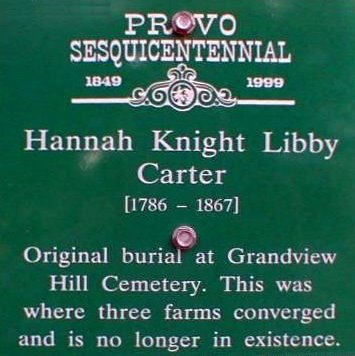 |
| Sign at Provo City Cemetery |
Shortly
after her death, the body was originally buried at the Grandview Hill Cemetery.
This was where three farms converged and is no longer in existence. She was
moved along with her head stone to the Pioneer Cemetery in Provo, Utah. On Memorial Day, May 30, 1941, 155 years
after her birth, 90 years after she crossed the plains, and 74 years after her
death, 90 members of her posterity held a memorial service in her honor, sang
again the songs that were sung at her funeral, and listened to a sketch of her
rich life story. Then once again they gathered at her graveside (in the Provo
City Cemetery) and dedicated a bronze marker as a lasting memorial to her name
and noble character. It bore this inscription (beside the motif of a covered
wagon):
Hannah Knight Libby Carter
October 9, 1786-November, 1867.
“Faithful in the day of Trial.”
 |
| Hannah's 1941 Marker |
 |
| Bench to remember Carter children that have no headstones. |

With
this we end this account of her life. May
her ability to overcome trials and adversity be an example to us. Also might each of us embrace truth with the
strength that she demonstrated. Hannah
was a great example to her posterity of how to live an honorable life.
Wednesday, April 26, 2017
HANNAH KNIGHT LIBBY - Part 25 - Crossing the Plains to Salt Lake
The years 1850 to 1852 saw the Carter families cross the
plains from Winter Quarters/Kanesville to Salt Lake City in three groups. The first to cross were William Furlsbury,
John Harrison and their sister, Hannah Carter York and their families. They crossed the plains with the William Snow
Company, leaving on 21 June 1850 and arriving in Salt Lake on 1 to 4 October
1850. The last sibling to come was Eliza
Ann Carter Snow who traveled in her husband, James C. Snow’s Company. They left Iowa on 5 July 1852 and arrived in
the Salt Lake Valley on 9 October 1852.
In addition to her family they also brought the Richard and Hannah
Parker Carter orphans – Franklin Fitzfield, Mary A and Samuel Parker Carter.
This leaves us with Dominicus, who by several accounts
brought his mother Hannah along with his family in 1851. The Church is developing a comprehensive
database of the pioneers who crossed the plains called “Pioneer Overland Travel”
– see: https://history.lds.org/overlandtravel/ It is a database that is incomplete and
constantly being updated. The irony is
that 1851 is the biggest weak line. The
Brethren encouraged all that could travel to come to Utah that year. In response there were many groups that
crossed the plains that year but they were poorly documented. Not one group has yet been fully accounted
for at this time. So this leaves us to surmise the best we can what transpired
in Hannah’s crossing the plains.
So the question becomes when in 1851 did Dominicus and
Hannah cross the plains. Most of the
accounts of Dominicus life state that he arrived in Utah in June, 1851. To do that they would have had to leave in
early spring before the snows had melted.
That just seemed to this writer to be too early for them to arrive. After much futile searching it was decided to
locate Dominicus’ obituary – which is located at Familysearch.org in his
memories in Family Tree. This obituary
states "From Nauvoo he migrated to Boniplat, Iowa, and resided one year at
Mount Pisgah, he removed thence to Council Bluffs, whe he resided two
years. He left the latter place on the
20th of June, 1851, and arrived in Salt Lake City on Sept. 25 of that
year. Two months later he came to Provo
(Nov., 1851) where he has resided ever since." ("A Veteran
Gone," Published in the Territorial Enquirer, 5 Feb. 1884. Seen in Journal
History of the Church, Vol 5, Feb. 1884, page 7.) This is the only place where
this writer has found absolute beginning and ending dates for their journey.
There is one other source that provides an extra tidbit of
information. Dominicus crossed the
plains in 1851 according to the record in Frank Essholm’s book published in
1913 at Salt Lake City—a 4500 copy by subscription edition—Pioneers and
Prominent Men of Utah, page 281. This record shows his picture and states
“Dominicus Carter a native of Maine came to Utah in 1851 with Captain Homers
Co.” A search for Captain Homer’s
Company has located no further references to the supposed wagon train. There was a supply train that arrived in Salt
Lake in late September what was lead by a Captain Horner. In looking closely at a copy of Essholm’s
book Homer could in fact be Horner, which would explain the non-existence of
Captain Homer.
 |
| Typical Wagon |
Without any absolutely related documentation of their
travels the following will have to suffice to help us to picture what this trip
must have been like in 1851 (or thereabouts.)
To go west by wagon and teams was not cheap. People had to obtain their
own outfits or pay to go with someone else. President Hyde reported in 1850
that outfits that year cost about $600 each, equivalent in today’s dollars to
about $13,000. It was not wise for any to head for Utah
unless they had “team and wagon sufficient to come through without any
assistance from the valley,” the First Presidency instructed from Utah in June
1849. “And they should bring breadstuffs sufficient to last them a few months
after their arrival.” (The Ensign Magazine, August 2002 – “Pushing on to Zion:
Kanesville, Iowa, 1846–1853” By William G. Hartley)
Ironically the year 1851 was a year of low emigration. With the Mormons, Oregonians and Gold Rushers
1848-1850 had been boon years. There was
a significant drop off in 1851 but things picked up significantly in 1852. The latter year (1852) was significant for
Mormons as the First Presidency essentially told all remaining Saints in the Kanesville
area to pack up and move to Utah and abandon all holdings in the States. Four letters detailing this shut down of the
settlements in Iowa were sent from Salt Lake during the 1851 year – at the time
Dominicus packed up and left. (See: BYU Studies Quarterly, Vol 52, Issue 3,
Article - 10-1-2013 - The Closedown of
LDS Iowa Settlements in 1852 That Completed the Nauvoo Exodus and Jampacked the
Mormon Trail by William G. Hartley.
Online at http://scholarsarchive.byu.edu/cgi/viewcontent.cgi?article=4463&context=byusq)
The initial cost of the outfit was just the beginning of the
costs. You then had to pay for food to
keep you alive and to pay to cross rivers (on bridges or on ferrys.) Since it
was impossible to carry enough food to feed your family during the whole trip,
it was essential to have funds to resupply your stores as your traveled. Prices
for foodstuffs varied widely from year to year and trading post to trading
post. The following demonstrate this
from 1850 and 1852 since no figures could be found for 1851. In 1850 prices at Fort Laramie were as
follows: Flour $.12 to $.50 per pound;
Sugar $.50 to $2.00 pound; Coffee $.50 pound; and Bacon $.50 pound. In 1852 before Fort Laramie: Flour $.20
pound/$15.00 per 100 pound; Sugar $.50 to $.60 pound; Coffee $.50 pound. At Fort Laramie in 1852: Flour $10.00 to
$10.50 per 100 pounds; Sugar $.50 to $.75 pound; Coffee $.40 pound; and Bacon
$.15 pound. (The Plains Across - The Overland Emigrants and Trans-Mississippi
West, 1840-60 by John D. Unruh, Jr. [University of Illinois Press – 1979] pp.
276 and 283.)
 |
| Ferrying the Platt River |
Crossing rivers was an expensive process if they couldn’t be
forded. With 1851 being a high river
year the use of ferrys and bridges was essential. Cost ran anywhere from $1.00 to upwards of
$10.00 per wagon and often $1.00 per horse.
Bridges were an extra bonus as they cut down the wait that often
occurred at ferry crossings as wagons would back up for days at many ferry
passings.
The modern
roadmap was not in use in the early days of travel across the plains. There were maps but they were expensive and
in short supply. Instead there were
guide books that were produced to help travelers in their journey. Perhaps the most famous of the guidebooks
available to the Mormons and other emigrants was Lansford Hastings’s The
Emigrants’ Guide to Oregon and California, which was written in 1844 and
published in Ohio in 1845. Hastings is best known for forging the trail through
Emmigrant Canyon into the Salt Lake Valley that the Saints so benefitted
from. He is forever linked in infamy
with the Donner Party whose demise was partly due to following the “Hasting’s
Cutoff.” Of more value to the Mormon
emmigrants was a guide written by William Clayton. Clayton was charged with keeping a journal of
the first pioneer wagon train of 1847.
His notes were later published as “The Latter-Day Saints Emmigrants’
Guide” which became an instant success with the Mormons and the Gold Rushers
headed to California. (William E Hill, “The
Mormon Trail” [published by Utah State University 1-1-2006] see: http://digitalcommons.usu.edu/cgi/viewcontent.cgi?article=1098&context=usupress_pubs) Mr. Clayton, the original publisher of this
Guide, is justly entitled to much credit and great praise for his diligence,
care, perseverance and untiring industry in measuring the distances from point
to point on this route, in describing the country, in pointing out the streams
and springs of water, showing the distances in English miles, from one camp
ground to another, so that the traveler may always know, when he starts in the
morning, how far he has to go before he finds another suitable stopping place.
("Emigrants' Guide to Salt Lake and California," Frontier Guardian, 7
Feb. 1851, 2. See: https://history.lds.org/overlandtravel/sources/6644/emigrants-guide-to-salt-lake-and-california-frontier-guardian-7-feb-1851-2)
 |
| Wagon Train Crossing the Plains |
In researching
this part of Hannah’s life one detailed account of a wagon train crossing the
plains in 1851 was located. It is found
at FamilySearch.org in the Family Tree
attached as a memory for Elizabeth Carson Griffeth (“On the Trail With the
Carsons in 1851” contributed by Nyla Skinner).
The Carsons traveled in what came to be called the Garden Grove Company
as they left Garden Grove, Iowa on May 17th and left Winter Quarters
on July 3rd (about 3 weeks after Dominicus left) and arrived in Salt
Lake City on Wednesday, September 24 (the day before Dominicus arrived.) Thus their two wagon trains surely shared the
trail and probably were in communication with each other. The experiences of the Carson group probably
parallel what happened to the Carter wagon train to some extent. The following excerpts from the Carson
article follow.
In 1850, an
article in the Frontier Guardian stated that the average fully loaded wagon
weighed about 1,850 pounds. For each person, old or young, it was recommended
that one hundred and twenty five pounds of flour be taken, "plus bacon,
sugar, coffee, tea, rice, dried fruit and other necessaries in
proportion." … Each family would also have stocked their wagons with clothing,
household goods, cooking utensils, tools, farming equipment and seeds. The article in the Frontier Guardian also
recommended that for each wagon, the family should have "two good yoke of
oxen and from one to three yoke of cows." If those traveling in the
company have even four or five oxen, or cows with them, it means they are
moving at least three hundred head of livestock. Most families also have
several horses. Herding this large group of animals, finding food for them, and
keeping them safe from the Indians is a daunting task that requires a good
portion of the labor each day.
Winter
Quarters had been abandoned since 1848 and was virtually a ghost town falling
into ruins. By the time the Carsons left
Winter Quarters on July 2 the Elkhorn River had rose so high they had to make a
100 mile detour to travel to the head of the river so they could cross it. A day into their journey they met the party
of Brother Orson Hyde traveling east from Salt Lake. Surely Dominicus’ group probably passed him
on the trail too. The Carsons described their early challenges
in getting their oxen teams to travel the route they desired and how it took
quite some time to train the animals and drivers on how to accomplish this
task. They then encountered Indians along
the Elkhorn that drove off cattle and horses.
They also endured more than one spontaneous stampede of their livestock
which lead to a couple of the party being trampled to death. One day they crested a hill only to find
gigantic herds of buffalo heading their way.
It took hours for the beasts to pass them.
By late July
the wet cool Spring had turned to a dry, hot summer. Mountain Fever, or malaria, became a problem
on the trail thanks to the wet spring conditions. The disease is spread through water. None of
the pioneer accounts I have read have described how they washed and bathed
while on the trail, nor how they took care of other basic needs. They had no
toilet paper, and I doubt they carried a four month supply of "corn
cobs." It was customary at the time to make use of small pieces of cloth.
These, naturally, were washed frequently in the streams. This is why it was
possible for the disease to spread so rapidly.
 |
| Wagon Ruts in Wyoming |
The pioneers passed
several natural landmarks such as Chimney Rock, Lone Tree and Devil’s
Gate. Heading into Fort Laramie (or Fort
John in those days) the landscape changed drastically from grasslands to dryer
vegetation, sage and cactus. This meant
that livestock would now need more feed to survive. Fort Laramie was a trading establishment of
12 houses enclosed in a wall 11 feet high.
He buildings were built of adobe – which the pioneers would see much of
in the coming months. Wagon trains would
stop here to trade, to use the blacksmith shops to make repairs and generally
rest up. This fort was approximately
half way between Winter Quarters and Salt Lake City.
The pioneers
tried to keep spirits up with dancing, songs and story telling in the
evenings. These activities were
important to break the monotony of the days and give the travelers something to
look forward to. This was often a 7 days
a week journey with only part of the day on Sunday’s taken out to worship. The trip was always arduous at best. It was hard to keep everyone happy. Discontent seemed to raise its head in every
wagon train. The trail included loose
cobble stones, ravines and creek beds to pass.
Wagons were forever having souse wheels.
Every company needed a blacksmith traveling with it to help keep the
wagons in repair. (Dominicus would be
very helpful to have around in this case.)
By late
August the company spent a week traveling through a bleak and dangerous
landscape of mineral springs, alkali beds, and poisonous swamps. It was
remembered that many of the families lost cattle to the alkali during this
portion of the trek. The only good thing
about this alkali land was the women could gather “salaratus, or soda, since
this was the only source of this mineral on the trip. It could be used in place
of yeast in baking. Upon reaching the Sweatwater River they passed
Independence Rock. On August 31st
they reported that three companies were traveling together – the Garden Grove
Company captained by William Walton, “Captain Brown’s” Company, and “Father
Allred’s” company. These companies would
have been in competition for good camping places and for feed for their
livestock.
As they
passed from Nebraska into Utah their trials were not over. The land was still dry and oxen died daily
from exhaustion, lack of adequate nourishment and water. This problem wasn’t resolved until they
finally reached the Green River. By this
time they were only 120 or so miles out of Salt Lake but the teams were giving
out and provisions were growing short. The
companies were throwing away all they could possibly spare in order to lighten
the loads. It appears that all of the companies that were nearing Utah at this
time were experiencing the same difficulties - shortages of food, and livestock
dying nor near death from exhaustion. On
Tuesday, September 16th 1851 the company arrived at Fort Bridger and
drove pass it a mile or so and camped.
There they divided their teams up in preparation for crossing the passes
of the Rocky Mountains that were ahead of them as it would take cooperation of
all the families to make this last crossing.
They were just 112 miles from Salt Lake but the challenges were not
over.
 |
| In the mountains east of Salt Lake City |
The final
week of their trek was not described – probably from the extreme exhaustion
everyone must have had in crossing the mountains. Others described the beauty of the scenery
and the comfort of not having to breathe dust all day like they had done for
months. On Saturday, the 20st of September, the Carsons were about seventeen
miles from the valley. Here, the pioneers probably had their first view of the
Salt Lake Valley. From the summit of a mountain which the Emmigrants’ Guide
described as being 7245 feet high, it was possible to see in the distance the
south part of the Valley. Here they met several men with teams ready to assist
those who needed help. ... The descent of the mountain was awfully steep and
dangerous for about four miles. The next two days saw them travel a whole 4
miles over the roughest, most treacherous landscape they would pass on the
entire trip.
On Wednesday,
September 24, 1851 the Garden Grove company had breakfast and then moved up and
over the last hill and entered the Salt Lake Valley with 60 wagons. The next day it is reported that Dominicus
arrived. Hopefully this account gives
the reader a taste of what the journey for Dominicus and Hannah was like.
Saturday, April 22, 2017
HANNAH KNIGHT LIBBY - Part 24 - Carterville Interlude
 |
| The Grand Encampment (https://history.lds.org/place/pioneer-story-grand-encampment?lang=eng) |
The first Mormon evacuees arrived in the Council Bluffs area
on June 14, 1846 after a trip of 255 miles and four grueling months. Because there was insufficient means to
transport the travelers across the Missouri River, they stopped short of the
river in an area that became called the Grand Encampment. These first wagons camped close to the banks
of the Missouri and as new wagon trains came they would stop just east of the
last group that had arrived. By the time
the needed ferry had been built about the first of July, the Grand Encampment
had grown to cover an area of nine miles east to west and three miles wide
north to south. This mass of some 10,000
people, wagons and livestock completely overwhelmed the ability of the ferry to
help them to cross the river.
This large a group gathered in one location quickly became
apparent that there wasn’t enough grass for the grazing animals and wood for
fires and other needs quickly became scarce.
A few of the Saints were able to cross over the river but the rest were
dispersed out from the Grand Encampment to between 80 and 100 smaller
communities in a 30 mile radius out from the Council Bluffs area. Carterville, some two miles north and east of
the original stopping place would become one of these settlements.
Brigham Young and the rest of the leadership of the Church
still had hopes of a group continuing on to the West but as the year was
rapidly passing and it was already late into the travel season the decision was
made to stay in this locality and wait for the following spring before crossing
the Rocky Mountains.
We know that Hannah and much of her family were in the Grand
Encampment by July 1. It is doubtful
that they had been dispersed prior to that day date. It was while they were in the Grand
Encampment that the long arm of the United States government reached out to the
despised and displaced Mormon gathered there.
Following the 1845 annexation of Texas by the United States,
tensions with Mexico grew until on April 26, 1846 fighting broke out between
the U.S. and Mexico. On May 13th
war was officially declared. At this time the Mormon refugees were in the midst
of crossing Iowa. While crossing Iowa
Brigham Young and the rest of the Quorum of the Twelve had petitioned President
Polk seeking assistance from the Federal Government. On June 2nd President Polk
authorized Col. Stephen W. Kearney to recruit a few hundred Mormons to help in
the war but to also “to conciliate them, attach them to our country, and
prevent them from taking part against us.” (Polk, James K. (1929), Nevins,
Allan, ed., Polk: the Diary of a President, 1845–1849, London and New York:
Longmans, Green & Co., p. 109) This
was a symbiotic relationship as Church benefitted greatly from the financial
benefits they received from this arrangement.
Young and the other leaders saw nothing but good coming from this
arrangement. Their enlistment would be a
public relations victory for the church, demonstrating additional evidence of
its loyalty to the United States. (McLynn, Frank. Wagons West: The Epic Story
of America's Overland Trails. Grove Press. pp. 386–7.) As the men were given a
uniform allowance at Fort Leavenworth, Kan., of US$42 each, paid in advance,
for their one-year enlistment and as they were allowed to wear their civilian
clothing for the march, the bulk of those funds were immediately donated to a
general Church fund. These funds were used to purchase wagons, teams, and other
necessities for the American exodus (Actual wages paid over the next year to
the Mormon Battalion totaled nearly $30,000). ("The Pioneer Story: Pioneer
Trail Map", LDS.org, archived from the original on March 5, 2012.)
 |
| Mormon Battalion Ball (by C. C. A. Christensen) |
So how did all of this affect the Carter family? Hannah and the other Carters were in the area
when Captain James Allen met with Brigham and the other Church leaders and put
forth his proposal for 5 companies of 100 men.
Though Brigham was thrilled with this prospect as noted above, the
general populace of the Grand Encampment was not. Richard Carter, Hannah’s youngest surviving
son, was one of the early volunteers as he was enrolled in Company B. Brigham was assured by Captain Allen that the
Battalion would see so battle action but would instead fill a supporting
role. Thus, Richard would not face many
more dangers than the Saints as a whole endured in their travels. As the day of mustering (July 16th)
approached they held farewell dance in the Bowery at the west end of the Grand
Encampment. The Carter family probably
attended with heavy hearts. On the 16th
Richard said his good-byes and marched off to his destiny.
Twenty members of the Mormon Battalion died during the
march. All died from diseases or accidents
- as the Battalion never had to engage
in any military actions. The 2000 mile
trek from Council Bluffs to San Diego was arduous and three different sick
detachments were sent back to Pueblo, Colorado and then back to Council Bluffs. Richard was a member of Lieutenant Willis's
Pueblo detachment. He died 25 Nov 1846 as the detachment was traveling north
along the Rio Grande. No grave marker memorializes
his last resting space though it is reported he was buried at Puerbelo, fur
miles south of Socow, New Mexico along the Rio Grande. Hannah’s heart must have been broken when the
word made it back to Iowa that her son had died. He left a wife, Hannah, and two young
children. Tragedy would strike this
family again in Winter Quarters when Hannah died of smallpox sometime in 1851. The children were cared for by Eliza Ann
Carter Snow’s family and made it to Utah with the wagon trains of 1851.
 |
| (https://winterquarters.byu.edu/Settlements/KanesvilleArea) |
The Carters were dispersed from the Grand Encampment and
settled some two miles northeast of the Bowery along the trail into Council
Bluffs. The community was named
Carterville and it was here they made their home for nearly 5 years when they
would leave for Utah. Hannah most likely
lived with Dominicus and his family though many of her family were probably
also in the immediate area. The location
of Carterville was significant as it was the first community travelers on this
portion of the Oregon/Mormon Trail would pass through. The Carters being mostly blacksmiths were
located ideally to provide repairs to the travelers. A story is told of William Furlsbury coming
in to eat lunch each day and emptying his pockets of piles of coins he had
already earned repairing wagons of those passing by. These funds were given to
the Brethren and helped to fund the needs of the community as a whole. (William
actually moved to Kanesville – modern day Council Bluffs – sometime during this
period.)
 |
| Kanesville Tabernacle (restored) |
While living in Carterville with her son Dominicus, Brigham
Young was sustained as the second Prophet of the Church and the First
Presidency was formally reorganized:
It was discussed occasionally that
the First Presidency would be reinstated and it was clear that Brigham Young
would be the one most likely sustained as the Prophet and President of the
Church. On December 5th, 1847, the
Quorum of the Twelve met at Orson Hyde's farm home about eight miles southeast
of present day Council Bluffs.
A unanimous approval reorganized
the First Presidency with Brigham Young as Prophet and President, Heber C.
Kinball as First Counselor, and Dr. Willard Richards as Second Counselor. The Quorum of the Twelve Apostles comprised
of Brigham Young, Heber C. Kimball, Parley P. Pratt, John Taylor, Wilford
Woodruff, George A. Smith, Orson Hyde, Willard Richards, Lyman Wight, Orson
Pratt, Amasa Lyman, and Ezra T. Benson.
The precedent set in the tabernacle of reorganizing the First Presidency
following the death of a Prophet continues today.
Church policy is to sustain the
reorganization by church members.
Immediately, Bishop Henry W. Miller was assigned the task of building a
tabernacle large enough to accommodate a large gathering of the members in
order to present and sustain the new First Presidency. A log tabernacle was built in the near
downtown area of current day Council Bluffs, and the gathering occurred on
December 27th. This means that Bishop
Miller had to build the 60' x 40' tabernacle in approximately 18 days. This allowed him 2 or 3 days to gather 200
men to complete the monumental task in a cold and bitter December. The building would need to accommodate 800 to
1,000 people, and was packed when at least 1,000 showed up. (http://www.allaboutomaha.com/Omaha/Mormons/KanesvilleTabernacle.htm)
There is no record of Hannah, or the other members of the
Carter family attending this event but they lived so close it is highly likely
that they were there or at the General Conference on 6 April 1948 when Brigham
was again sustained as the Prophet.
This was only a temporary arrangement, and indeed the
Carters hoped to be with the first wave of emigrants to cross over the Rockies
with Brigham but they were asked to stay behind and help outfit those passing
through. Though we know very little of
this time period we can assume that it was a relatively peaceful interlude
compared to the previous ten years.
Hannah would be able to watch her grandchildren grow up in a climate
much safer than that which they had left.
Of her family left in Illinois we can only guess that Hannah probably
corresponded by mail with them on occasion.
Eventually the call would come to head west but that is another story.
Sources:
Coleman, Arthur D, “Carter pioneers of Provo, Utah : a
biographical, genealogical and historical account of the Dominicus and other
Carter families” (1966).
Carter, Barton L, “Dominicus Carter Latter-day Pioneer”
(1997)
Scharrer, Leora Carter, “Life of William F. Carter” (197?) FHL
921.73 A1
Jensen, Andrew, “The Historical Record, Vol. 9” (1890)
Wikipedia Articles – “Mormon Battalion,” “Winter Quarters,” “Mexican-American
War.”
Mormon Battalion Fact Sheet (http://www.mormonnewsroom.org/additional-resource/mormon-battalion-fact-sheet)
Mormon Local History (http://www.allaboutomaha.com/Omaha/Mormons/index.htm)
Historical Pioneer Research Group, “Early Latter-day Saints –
A Mormon Pioneer Data Base” (http://earlylds.com/index.php#Walk Where They
Walked - Visit Historic Sites)
Subscribe to:
Posts (Atom)