Richard Harrison Carter – Mormon Battalion
Pioneer
By Robert Givens (August 20, 2020)
With the 200th anniversary of Richard Carters birth approaching, this is an appropriate time to revisit his life in an attempt to construct an accurate depiction of his life and times. Until now there was only one compilation of his life written by his great niece, Almira T Bethers, and filed in the Daughters of the Utah Pioneers collection. On reading this account of his life it was easy to identify several instances where recent research has proven statements in that account of his life to be inaccurate. That being said, this account of his life will still rely heavily on the earlier biography when possible.
Birth and His Family
On 20 August 1820 a son named
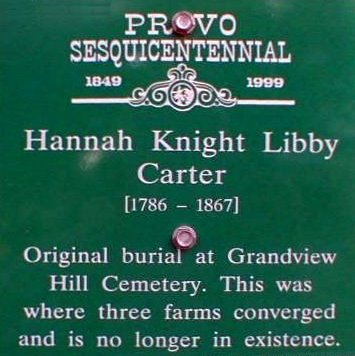
Richard Carter was born to John Carter and Hannah Knight Libby Carter in Newry,
Oxford, Maine. (Office of Town Clerk, Newry, Maine, Town Records, 1805 - 1846,
Family History Library film #11589, pages unnumbered) John and Hannah were in
their mid to late thirties and this was the ninth child born to them and
Richard was their sixth son. In a time
when there was high infant mortality the Carter family was fortunate in that they
had only lost one child previously, John Harrison, who had died on 11 April
1815 in Newry at just short of three months of age.
John Carter and his wife were both from families that had been in the Americas since at least the mid-1600’s. John Carter’s parents, Richard Carter and Jane or Anne McKenney Carter lived in Scarborough, Cumberland, Maine. The farm on Broadturn Road had been in the family going back to at least John’s grandfather, Benjamin Carter. Richard had inherited the farm from his father and had purchased several tracks of land in the vicinity increasing his holdings significantly. It was surely this Richard Carter, his grandfather, that the baby born in 1820 was named.
Hannah Knight Libby was also born in the Scarborough area quite close to where John lived. Today the old Libby farm is located on Watson Mill Road in Saco, Maine and is just a mile or so to the west of the land owned by John Carter. Hannah’s parents, Zebulon Libby and Lydia Andrews had inherited this land from Zebulon’s father, Thomas, who had accumulated a large tract of land, of which the Zebulon Libby farm was but a portion. Zebulon was a patriot having served three years in the Revolutionary War, and was afterward a captain in the state militia.
Little is known of John Carter’s early life until in 1804 a remarkable deed is found that describes his purchase (with another man) of a home in Portland, Maine. John is described as being a “mariner” on[RG1] the deed. Family lore has always said that he was a sea captain at one point in his life and that rumor, at least, has some substance as the 22-year-old John was living in one of the main seaports of New England in 1804. Unfortunately for John, by 1806 the prosperous trade business in Portland virtually shut down as the British passed the Non-Intercourse Act that essentially said any American ships not trading with the British could be confiscated and their crews held. This act would be one of the main actions that would lead to shortly to the War of 1812.
John did not long remain in Portland. On 7 Nov 1805 John purchased 72 acres of land that was between the farms of his parents and Hannah’s parents and on 2 March 1806 John and Hannah married. It was on this farm that their first three children – Dominicus, Almira and Hannah – were born. By 1809 John had sold half of his Scarborough land and was purchasing land in upstate Maine in Newry. This was undeveloped land and it apparently took him some three years to clear and develop it sufficiently to actually move his young family to this remote community. But move they did, and it was on their farm in Newry that the rest of their family were born. Before Richard was born, they had five children in Newry – William Furlsbury, Philip Libby, John Harrison (who died in 1815), another John Harrison and Eliza Ann. After Richard two more children would be born here, Mary Jane and Rufus, who died on his second birthday in 1827.
Early Life
It is true that we know very
little about Richard in his early years but we can assume many things base on
what we know about life in Newry and nuggets of information found in the town
records. The first thing we learn is
that when the family registered their children in the town records he was
recorded simply as Richard Carter. He
was not listed with a middle name. It
doesn’t mean that he wasn’t born Richard Harrison but it wasn’t until the
Nauvoo time period that we find him with a middle name.
By 1820, when Richard was born, the Carters had been in Newry for about a decade and were firmly established there. Life in Newry was close to being at a subsistence level. Farms had to be as self-sufficient as possible as this northern forest land required great effort to clear and the growing season was short. Most of the arable land was used to grow foodstuffs for the family or to produce forage for their animals. Hunting, trapping and fishing was important for food and for the skins that could be traded for needed food. The forest, which was everywhere and plentiful, was a source for logs and cut timber. Still the bottom line was everyone needed food so food was king. John Carter had an extra skill that would help them in this time of resettlement. He had learned the blacksmithing trade since his marriage to Hannah. He probably learned this from Hannah’s father Zebulon Libby who was a farmer-blacksmith back in Scarborough. John most likely plied his trade on the side accepting barter in commodities which his family would need. (Life Story of Hannah Knight Libby Carter, p. 36 at https://www.familysearch.org/tree/person/memories/KWVM-MGY)
From 1820 to 1827, few or no details about the family are known. The family farm seems to have done well. For the most part John tilled 1.5 acres, though some years just a half acre. He consistently mowed 2.5 acres to provide food for his livestock and finally had about one acre of pasture. His livestock usually consisted of two oxen, a horse, between 2 and 4 cows, between 2 and 8 cattle, and between 2 and 5 swine. Assuming that John was probably earning extra income from blacksmithing, the family was probably doing fine by Newry standards. (Life Story of Hannah Knight Libby Carter, p. 39 at https://www.familysearch.org/tree/person/memories/KWVM-MGY )
These were the formative years of Richard’s life. His older sisters Almira and Hannah probably played a big part in helping their mother in raising the young Richard. The education he did receive was probably from his mother while sitting at her knee. It was likely that from his early days he was trained in working on the family farm and by age seven he was being given chores to do to help the family.
1828 – 1833
The dynamic of the John Carter family began to change in 1828 and with this Richard must have had to take a more important role in helping run the family farm and business. In 1828 and 1829, when Richard was just 8 and 9, his three oldest siblings married and left the home. In May of 1828 Dominicus married Lydia Smith. In January 1829 Almira married Alvin Baron Tripp and in December of the same year Hannah married Aaron Mereon York. When Richard was just 12 William married Sarah York. Thus, by the time he was 13 the family living at home consisted of Philip age 21, John age 16, Eliza Ann age 14, Richard 13, and Mary Jane 10.
With the family shrinking Richard’s role in the family probably grew rapidly. Richard and his brothers, John and Philip, would have had plenty to do with clearing land and probably helping their father with his blacksmith work. In any case, this was the way of life in the 1800’s – the sons helped on their family farm until they were old enough to marry and go out on their own.
1834 – 1838
There are often seminal events
that change the course of a family’s experience. This event could be natural disaster, an
accident or a war. The event that
changed the course of the life of the entire Carter family was the sickness of
Richard’s mother, Hannah, in early July 1834.
This event would have a lasting impact on each and every member of the
John Carter family. It was on 4 July
1834 that Mormon missionaries, Daniel Bean and John F. Boynton, appeared at the
Carter home and while healing Hannah of her sickness also brought the message
of the restoration taught by the Church of Jesus Christ of Latter-day
Saints.
Daniel Bean was a first cousin once removed of Sarah York and Aaron M York, spouses of William F Carter and Hannah Carter – older siblings of Richard. Daniel was baptized in 1833 and lived some 15 miles from Newry. He was paired up with John F. Boynton, who had joined the church in Ohio. They had been traveling through towns in the backwoods of Maine having much success converting people to the Gospel. It appears that they had actually baptized Richard’s oldest sibling, Dominicus and his wife, Lydia just days earlier on 30 Jun 1834.
Thus, we come to 4 July 1834. John probably had sent one of the children living at home to make the short trip to the homes of his married children informing them their mother’s grave illness and possible impending death. Fortunately, we have one account of that day thanks to the then 15-year-old Eliza Ann Carter Snow who wrote of that day in a short diary recorded in 1892. In her own words here is her account of that day: “I first embraced Mormonism in 1834, in the town of Newry, Oxford County, State of Maine. The first Mormon elders I ever heard preach were John F. Boynton and Daniel Bean. They came to my father's house, and my mother lay very sick. The doctors had given her up. The elders told her they were preaching a new doctrine and they told her that she could be healed if she could have faith, that they would hold hands on her. They did lay hands on her and said, 'In the name of the Lord Jesus be thou made whole.' And she was made whole and arose and called for her clothes and said I must go to the water. She walked one-half mile and was baptized in the river called Bear River and confirmed. And there was a large branch raised up in that place." (Eliza Ann Carter Snow, Autobiographical Sketch, 1892 April 10, LDS Church History Library, MS 9676 – microfilm of the original handwritten record transcribed by the author, 14 Feb 2012.) The quote of the day was John’s comment on this event, “That beats doctor bills.” (Ibid.) It should be noted that the date of the baptism is not recorded by Eliza Ann, or anyone else in the family for that matter but is recorded in the records of the Church.
The joy that Hannah experienced surely led her to want her other children to partake of this new faith of hers. Along with Dominicus, who appears to already be a member, Hannah was joined in baptism by her children John H (age 18) and Eliza Ann (age 15) on the day their mother was baptized. The exact baptism date of the subject of this sketch, Richard Harrison (age 13), appears to have been about 31 Oct 1834. Two other married children William F (baptized 17 Nov 1834) and Hannah (who appears to have waited until 1844 to be baptized) shows the effect of the married children having a harder time to convert. Her oldest daughter Almira, who was already married in 1834 never did join the church. The then 21-year-old son, Philip Libby, soon left home for Massachusetts and didn’t join the church either, though he and Almira and their families joined the family in Tioga, Illinois years later. Lastly, the youngest daughter Mary Jane, just 11 in 1834, never joined the church but lived with John and Hannah until her marriage in Missouri in 1840.
On 15 August 1835, Brigham Young and Lyman Johnson visited Newry. They held a conference at the home of David and Patty Sessions, and Brigham Young crossed the Androscoggin River to preach at the Middle Intervale Meetinghouse, in Bethel, which at the time was without a settled pastor. At the meeting in the Sessions home, Young spoke of “establishing Zion” somewhere in the west, a place where Saints could live together and practice their religious beliefs without fear of persecution. He encouraged the local Saints to sell their farms and travel to Missouri to join others in this endeavor. On August 21 of the same year, the Sessions were visited by another Mormon elder and missionary, William McLellin, who recorded in his journal that he had preached about two hours at a “bro Cessions… Brigham Young and other members of the Twelve Apostles visited Newry again in August 1836, and once more preached in at Middle Intervale. He again urged the members of the Newry branch to sell their farms in Maine and travel to Missouri where the Saints were gathering.” (Mary E. Valentine, WESTERN MAINE SAINTS, [Part 2] - A Newry Family Who Joined the Latter-Day Saints in Seeking a Home in the West, The Courier, Volume 29, No. 2 (2005))
The year 1836 witnessed the beginning of the division of the Carter family as the Latter-day Saint members began to heed the call of their Church leaders to gather in the West. The two married sons, Dominicus and William, did heed this call and left for Kirtland, Ohio in 1836 (probably in the spring.) At this point Richard’s mother Hannah faced a difficult dilemma. She had two single children, John approaching 20 and Eliza 18, who if they stayed in Newry, would find it difficult to find someone of the faith to marry. Surely it was their mother, Hannah, who was behind the fact that these two unmarried children left with their married siblings that spring and traveled to Ohio. Hannah would be vindicated for this move as both John and Eliza found mates and married within the Mormon faith during the short time they were in Kirtland. This left just four members of the family in the Carter home in Newry – John, the father, Hannah his wife, Richard, who would turn 16 in 1836 and Mary Jane, who was 13. At this point Richard’s role in the family grew as he was the only son left to help his father in his farming and blacksmith work.
1838 – 1841
In the short
biography of Richard (Treasures of Pioneer History – Stories of the Mormon
Battalion, pp. 456-7) it is stated that Richard, along with the rest of the
John Carter family, traveled with the Saints to Kirtland, Ohio and Far West,
Missouri. This just isn’t so. The evidence for John and Hannah being in
Kirtland is that there was a John Carter in the Kirtland Company that traveled
to Missouri. The problem with that fact
is that the John Carter of the Kirtland Company was in a party of 2 so this has
to be John Harrison Carter and his young bride, Elizabeth Runnels Sweet whom he
married in Kirtland in April of 1838.
The Kirtland Company left the Ohio gathering place between July and
October of 1838 for Missouri. At this
time Richard, Mary Jane and their parents were still living in Newry. The town records of Newry do give us an
approximate time of the family’s departure for the west. There is a notation in the Newry town records
that on 10 Sep 1838 that John Carter called the meeting that month and was paid
$1.50 for calling meetings that year.
This is the last mention of John while he lived in Newry. For on 25 October 1838 we read that Andrew N Stowe was chosen
in Newry as collector of taxes to fill the vacancy of John Carter. At the
same time Stephen E Frost was chosen to take John’s place as highwayman and surveyor. (Town
and Vital Records, 1805 - 1891; Newry, Oxford, Maine, FHL Film #11589, pages
unnumbered.) Since John was in attendance at the meeting of 10 Sep 1838, we can
narrow the date that John and Hannah left Newry to between mid-September to
late October 1838. Since the rest of the family had left Kirtland on July
5 of that year, they had a large head start but were making very slow
time. The Kirtland Camp groups were financially strapped and had trouble
obtaining supplies and therefore had to stop to work to earn money to buy
supplies. Their progress was extremely slow and they would not reach
their destination at Far West, Missouri until October 2nd.
The trip to Missouri for Richard and his family was accomplished in a very short time when compared with the part of the family who left Kirtland around July of 1838 and didn’t arrive in Far West until early October of the same year. Richard and his family left Newry between 10 September and 25 October and on 10 November 1838 Richard’s father John purchased 40 acres of land in Monroe County, Missouri. (Monroe County, Missouri, Deeds, Book E, p. 574 - Family History Library Film 975063) It is significant that Monroe County is three counties east of where the rest of the Latter-day Saints were settling in the Far West area.
Richard spent the winter of 1838 through early 1841 in Monroe County, Missouri. His father, John, had not been willing to move to the Far West area, which was a wise choice as by the time Richard and his family reached Missouri, the Saints were already being driven from their land and were making a winter pilgrimage eastward which would culminate in their settling in the Commerce, Illinois area, which in time, would be called Nauvoo. Richard and his family laid low during this time farming their land in northcentral Missouri. It was here on 27 Aug 1840 that Richard’s sister, Mary Jane, married Jacob Dooley. (Ancestry.com. Missouri Marriage Records, 1805-2002 [database on-line]. Provo, UT, USA: Ancestry.com Operations, Inc., 2007. Original data: Missouri Marriage Records. Jefferson City, MO, USA: Missouri State Archives. Microfilm. Marriage date – 27 Aug 1840 – Monroe Co., Missouri.) This left Richard as the last child living at home. His presence in the home as his parents who were growing older (his father turned 58 in 1840) must have been a great comfort to them. It is not an accident that Richard and his parents were keeping their distance from the main body of the Saints. Richard’s father, John, was not interested in getting involved in the mob actions directed towards the Saints. He surely had had communications with his Latter-day Saint children and he appeared to not want to be involved in that kind of life.
1841 – 1846
As
Richard’s immediate family continued to live in Monroe Co., Missouri, most of
the rest of the family had left Far West back in the winter of 1838 under the
direction of Isaac Morley and would ultimately settle some 33 miles south of
Nauvoo along the Hancock and Adams County lines near modern-day Tioga,
Illinois. It appears that John Carter
was not interested in getting his family into the middle of the “Mormon” issues
but along the way his wife, Hannah, must have convinced him that moving to
where the children settled would be safe because of its distance from Nauvoo. For whatever reason, we do know that by May
of 1841 they had moved to Morley Town or Yelrom settlement. At that time John purchased a tract of land, of
not quite 23 acres, from Richard’s brother William Furlsbury Carter. (Hancock
County, Illinois Deeds, Book I, p. 227 – 228 (FHL Film 954,598). Transcription
found in Susan Eaton Black, et. al., Property Transactions in Nauvoo, Hancock
County, Illinois and Surrounding Communities (1839 – 1859), Vol. II C-F, p.
749.)
So fully five years after the family had been split due to the westward migration of the Saints, Richard was reunited with most all of his family. In fact, except for his older brother Philip, who wouldn’t arrive in Morley Town until the mobs were driving the Saints out, virtually all the family was now living within a short distance of each other in southern Hancock County or across the county line in northern Adams County. It is not known for sure exactly where Richard lived at this time. Richard left no record of land dealings so it should be presumed that he probably continued to live with his parents.
One can’t help but think that Hannah had pushed to move to be near her children for more than to just be in their company. By 1840 Richard was 20 years old and surely Hannah hoped that he would marry someone in the Church. Living in central Missouri would have made that dream virtually impossible. They wouldn’t want to send him to Illinois to live with his siblings as then they would be without any help with their farm and other business. Thus, it is likely that the move to Illinois was motivated by a hope Richard could find a good Latter-day Saint young lady to marry while still helping his parents.
If the goal was to have Richard marry in the Church, then they were successful as on 29 Nov 1840 in Lima, Adams, IL Richard married Hannah Parker. ("Illinois, County Marriages, 1810-1940," database with images, FamilySearch at https://familysearch.org/ark:/61903/1:1:KFK3-XCJ : 5 November 2017), Richard Carter and Hannah Parker, 29 Nov 1840; citing Hancock, Illinois, United States, county offices, Illinois; FHL microfilm 229,486.) Hannah Parker was born in York County, Maine on 24 June 1822 to Samuel Parker and his second wife, Molly (Mary) Bracey Trueworthy. Samuel Parker was an early convert to the LDS Church in Maine. Hannah’s mother died in Quincy, Illinois in 1839. Her father would live to die in Council Bluffs, Iowa in 1846. Unfortunately, nothing else is known about her life prior to 1840. With no land records known for Richard it is possible that they lived either with Hannah’s family or with John and Hannah Carter after their marriage in 1840.
While living in Illinois, Richard and Hannah had two children who all the family have traditionally recognized. If the place of birth for their first-born child is accurate, they were possibly in Hancock County when their first child, Mary Trueworthy Carter was born 23 Sep 1841. There is some discrepancy with the births of Mary Trueworthy Carter and the next sibling, Samuel Parker Carter, as family tradition and his death certificate give his birth as 10 Feb 1842 which is too soon after Mary’s birth to be accurate. Without any evidence the family has changed Samuel’s birth to 1843 so the dates now work. Family tradition gives Samuel’s birth place as Lima, Adams, Illinois which is the home of Alvira Carter Tripp, Richard’s sister. It is possible that they had moved down there to live with her family or possibly the Parker family may have lived there.
In addition to Mary Trueworthy and Samuel Parker, it appears that Richard and Hannah had a third child born to them in Illinois, Angelina Carter. Little is known of her and in fact no primary sources can be found to document her birth in this family. That being said there is substantial secondary evidence to support her placement in the family. In recent years the BYU Center for Family History and Genealogy has tried to document all the Latter-day Saints that lived in the Nauvoo area in their “Nauvoo Community Project, 1839 – 1846.” They have Angelina Carter as born in 1845 in Lima, Adams, IL and died in 1848 in Mt. Pisgah, Union, IA the daughter of Richard Carter and Hannah Parker. (https://www.familysearch.org/ark:/61903/1:1:QL3Z-G94C) Her half-brother, Franklin Fitzfield Carter mentions her in his family record, and Hannah Parker Carter’s last husband Cornelius Brown, after Hannah died, told his subsequent wife that followed Hannah that he had buried Hannah and two children on the prairies of Iowa. In Union County, Iowa today is the Mount Pisgah Cemetery State Preserve which contains a 12-foot high white obelisk whereon are inscribed 60 of the presumed 300 people who were buried in the cemetery there. On the north side of the obelisk is inscribed Angelina Carter. This is the only record outside of family tradition to actually prove that she lived and died. For what it is worth, Franklin Fitzfield Carter had her sealed to Richard and Hannah in the Salt Lake temple in March of 1918. We should be grateful that Franklin didn’t want this little girl to be forgotten or we might not know of her today.
Richard and his young family passed through the persecutions in the Nauvoo area but absolutely nothing has been found regarding their specific experience. We know they were there as Richard and Hannah were the last of the Carter clan to take out their endowments in the Nauvoo Temple. They attended the temple to receive their endowments on 7 Feb 1846. The evacuation of Nauvoo was in process having actually begun 3 days before Richard and Hannah attended the temple. Since there is no record of their being sealed together in the Nauvoo Temple after 7 Feb 1846 it must be assumed that they left Nauvoo shortly after that date.
1846 – Exodus to Iowa
Richard
and Hannah left Nauvoo during the Mormon Exodus of 1846 as mentioned above
sometime after they were endowed on 7 Feb 1846.
There are no family records describing the crossing of Iowa during that
winter and spring. The travail of the
Saints as they fled west is well documented.
Depending upon when they actually left, they either had to plow through
snow drifts or later, after the spring rains, through mud making the trek
miserable and exhausting. It was this
journey that inspired William Clayton to pen his song “All is Well.” We do not know for a surety if Richard and
his family traveled with other family members or separately. All we know is that Richard and his family
arrived at the Grand Encampment east of the Missouri River in and around
modern-day Council Bluffs. The only
thing we know for sure is that they had to have arrived sometime prior to July
13 as later events will show.
1846 – Mormon Battalion
Following the 1845 annexation of Texas by the United States, tensions with Mexico grew until on April 26, 1846 fighting broke out between the U.S. and Mexico. On May 13th war was officially declared. At this time the Mormon refugees were in the midst of crossing Iowa. While crossing Iowa Brigham Young and the rest of the Quorum of the Twelve, through Jesse C. Little, President of the Eastern States conference of the Church, had petitioned President Polk seeking assistance from the Federal Government. On June 2nd President Polk authorized Col. Stephen W. Kearney to recruit a few hundred Mormons to help in the war but also “to conciliate them, attach them to our country, and prevent them from taking part against us.” (Polk, James K. (1929), Nevins, Allan, ed., Polk: The Diary of a President, 1845–1849, London and New York: Longmans, Green & Co., p. 109) This was an unusual symbiotic relationship, as the Church members as a whole had very negative feelings towards the government after receiving no redress from being driven from their homes, and the government who wasn’t willing to support the Saints in their time of need turning to them for help. Young and the other leaders of the Church did see this as an opportunity for some much-needed financial help and ultimately agreed to the arrangement. One author suggested that the Battalion’s enlistment would be a public relations victory for the church, demonstrating additional evidence of its loyalty to the United States. (McLynn, Frank. Wagons West: The Epic Story of America's Overland Trails. Grove Press. pp. 386–7.)
The men were given a clothing allowance at Fort Leavenworth, Kan., of US$42 each, paid in advance, for their one-year enlistment. The men generally used their own clothes so they wouldn’t spend all their pay. Ultimately about a quarter of these funds were sent back to Council Bluffs, some to their families, some to the Church, and some for the poor still in Nauvoo. The infusion of cash given to the Church was used to purchase food, wagons, teams, and other necessities for the Church exodus. The actual wages paid over the next year to the Mormon Battalion totaled nearly $30,000 of which about $6,000 sent back to Council Bluffs. ("The Pioneer Story: Pioneer Trail Map", LDS.org, archived from the original on March 5, 2012.) The reason more money was not sent back to the Saints was that the Battalion members still needed to provide for themselves so clothing, shoes and any personal gear that the Army didn’t furnish. The one added benefit to the Saints left in Iowa in addition to the funds that were sent, was that, thanks to the Army, the Saints had 500 less people to feed.
Richard Carter, Hannah’s youngest surviving son, was one of the early volunteers as he was enrolled in Company B of the Battalion. On July 13th an “All Camp” meeting was arranged at the Council Bluffs bowery where a call was made for volunteers. Captain Allen expressed to the Saints that the Battalion, as it was later called, would probably see no battle action but would instead fill a supporting role. What Captain Allen failed to tell was the extreme conditions that the Battalion would encounter in their trek – over a trail that was much more challenging than the Mormon Trail route the bulk of the Saints would take to Utah. The Battalion route was through deserts where food and water were scarce, they had limited rations, and struggled with their wagons through sand and hilly unimproved paths. Considering the arduous nature of their travels, it is amazing that more Battalion members didn’t succumb during this trek. In any case, the volunteers began to sign up with Captain Allen’s dragoons acting as clerks. Some officers were selected and three companies and part of a fourth were organized. Approximately 250 to 350 men signed up that day. That evening they held farewell dance in the Bowery at the west end of the Grand Encampment. The Carter family probably attended the dance with heavy hearts.
On July 14th and 15th the recruitment continued and four full companies were raised suggesting that Captain Allen now had approximately 400 volunteers. July 16th was formally Muster Day – the day the recruits were officially accepted into service. At mid-morning Captain Allen accepted the 4 and a half companies into service and assumed their command. He thereby was elevated to the rank of Lt. Colonel of volunteers. His first official order was to formally name this unit the “Mormon Battalion.” On the afternoon of the 16th the command marched about 5 miles south to Peter Sarpy’s Trading post at Trader’s Point where they established their temporary camp.
July 17th and 18th were taken up by the men outfitting as they drew some supplies (blankets, cups, plates, etc.) from Sarpy’s stockpile. The 18th, being a Saturday, a dance was organized in the afternoon at the Soldier’s Camp near Sarpy’s at 1 pm. At 5:30 that evening President Young and others gave them "their last charge and blessing," which included a promise that their "lives should be spared and [their] expedition result in great good, and [their] names be handed down in honorable remembrance to all generations." (William Hyde, The Private Journal of William Hyde (privately published, 1962?), 19; spelling standardized. Cited at: https://history.churchofjesuschrist.org/article/historic-sites/journey-of-the-mormon-battalion?lang=eng
On Sunday, July 19th most of the men were given furlough for the day. Many hiked back to the Bluffs to see family again. It is assumed that Richard most likely did this so he could see his wife and young children and parents one more time. The day was given to much preaching in the Bowery as the now Lt. Colonel Allen was still filling out his 5th company of volunteers.
The plan was to leave and head south on the 20th but the volunteers were not ready yet. More men actually enlisted that day. The 21st began with rain in the morning. This caused a further delay and they finally pushed off that afternoon and only made 3 or 4 miles to Mosquito Creek and had to encamp there for the night. On the next day (the 22nd), the last of Co. E left Sarpy’s and joined the main command and they all proceeded towards Ft. Leavenworth. (Ironically the first Battalion death occurred that night of the 22nd/23rd when Pvt. Boley died in camp.) Thus, it was on July 23rd Richard finally marched off towards Ft. Leavenworth and to his destiny.
Nineteen
or twenty members of the Mormon Battalion died during the march. All died from diseases or accidents - as the
Battalion never had to engage in any military actions, though they did skirmish
with Indians a couple of times in California.
The 2000-mile trek from Council Bluffs to San Diego was arduous and two
different sick detachments were sent back to Pueblo, Colorado and then on to
Utah or in a few cases to Iowa. Richard
was a member of Lieutenant Willis's Pueblo detachment of the sick. He and Pvt
Elijah Freeman, also of Co B, both died on 19 Nov 1846 as the detachment was
traveling north along the Rio Grande. Lt. Willis in his letter (transcribed
below) reported the graves were four miles south of Sacora on the Rio Grande. No grave marker memorializes his last resting
place. The modern-day spelling of the
earlier Indian village is Socorro, New Mexico, and can be found on the western
side of the Rio Grande River on maps of the region. (See https://en.wikipedia.org/wiki/Socorro,_New_Mexico)
(Much of the detail above and edits to the information from Lt. Willis’ diary below was graciously provided by Kevin Henson, a historian for the Mormon Battalion Association. They have an interactive map of the Battalion route at https://www.mapntour.com/viewer/?c=487 Their recent research has narrowed the last resting place of Richard as being between ¾ and 1 ½ south of Socorro.)
To try to provide the family with some feeling of what this journey was like in the last days of Richard’s life the following excerpts are from a letter dated 6 Aug 1869 written by Lt. William W. Willis found in the Church Historian’s Office correspondence files.
(see: https://catalog.churchofjesuschrist.org/assets?id=3442a609-08a3-41f4-ad8b-5c4629b96c58&crate=0&index=0) It must
be noted that his account was written many years after the fact and without his
original journal to refer to, so that are some inaccuracies which will be
noted.
The narrative begins with page 4 of the letter as Lt. Willis leaves Santa Fe. “I think, on the first day of Nov. Col Cook issued marching orders accordingly the Battalion marched with 40 (actually 60) days rations being the only outfit deemed sufficient for that mighty march. His mules and oxen being in very low condition having made the trip from the States our road lay down the Rio Grande passing through the principal settlements of New Mexico to a place called Sacora at this place Col. Cook took the right-hand side of the river no wagons ever having traveled on that side. His route lay over a rough rocky and sandy country so the Colonel attached ropes and pull and so walk that the wheels of the wagons would follow in their track. This labor was so hard that men were daily dropping under the excessive fatigue on the morning of the 10th Nov (I think) (actually Nov 3) the sergeant reported James Hamilton (Hampton) fit for service and before night he was dead he died in the wagon the team stopping about 20 minutes to let him depart as it were in peace in the evening where we camped we buried him.
We continued our march till about the 12th (9th) when Col. Cook called a halt… On that portion of the Rio Grande over which we traveled fruit and vegetables were abundant and we all eat freely of both then the hard and excessive toil and labor that we had to perform under the scorching heat of an almost tropical sun and the frequent use of the old iron spoon out of which all kinds of medicine was freely administered produced so much sickness in the ranks that the Col. Was obliged to order a halt and issued the following orders viz: …
iii That
Leiut W W Willis assume command of the invalids and that he call upon Capt
Berguin (Bergwin) at Alberquerque for assistance and report to the commander at
Santa Fe and for orders… Active operations now commenced to carry into effect
the forgoing orders and by 4 o’clock of same day we had collected fifty six
invalids one big government wagon, four yoke of poor cattle, five days rations
and two dressed sheep as a luxury for the sick Our bedding for the one wagon
consisted of the clothing blankets cooking utensils tents and tent poles and
their knapsacks(?) fifty six in number which surly made load enough, there on
the top of all that must be placed those that were unable to walk.
With some difficulty I got a spade or two and a shovel but was provided with no medicine or other necessaries for sick men and only five days rations for a journey of three hundred miles. Thus provided we commenced our lonesome march back to Santa Fee we traveled about two miles and camped and were visited that even by Capt Hurst (Capt Jefferson Hunt, Co A’s senior captain) and others who spoke words of comfort to us & blessed us administering the Church ordinances to the sick and bidding us God speed they left us.
Next day we resumed our march, in the evening camped near some springs of water, one yoke of our oxen got mired in the mud we took the yoke off and one got out the other we undertook to pull out but unfortunately broke his neck, our team was then too weak to pull our load, in the night Bro John Green died and we buried him by the side of Bro. Hampton (Nov 15th), what to do for team we did not know this was a dark time and many were the earnest petition that went up to our God and Father, to our joy the next morning we found with our oxen a pair of splendid good steers which cheered our spirits for we looked upon it as one of the kind providences of our Father in Heaven.
We marched two days more without meeting with any accident. The night of the 15th Nov.(16th) we camped as usual. Bro Elijah Freeman was to night taken very ill, we hauled him next day (17th) in our wagon, he suffered extremely this night camped as usual, lay by next (18th) day for the benefit of Bro. Freeman whose groans and lamentations could be heard throughout the entire day it was a very cold and snow day Next (19th) day we resumed our march. This day we halted for Bro. Freeman to die after which we continued our march till the usual time of camping we then buried his corpse To night Bro Richard Carter died next morning we buried him by the side of Bro Freeman, their graves are four miles south of Sacora on the Rio Grande…” (Note: spelling and punctuation are as written. Paragraphing is provided to help break up the narrative.) As to Richard’s cause of death, it was probably due to exposure and fatigue. No one will ever know for sure.
Richard had turned 26 on 8 Aug 1846 and died three months and 11 days later. Thus, ends the all to short life of Richard Harrison Carter. It is fitting to end this short biography with two quotes. The following is from President Brigham Young at the first reunion of the Mormon Battalion on 6 February 1855 where he stated:
The Mormon
Battalion will be held in honorable remembrance to the latest generation; and I
will prophesy that the children of those who have been in the army, in defence
[sic defense] of their country, will grow up and bless their fathers for what
they did at that time. And men and nations will yet rise up and bless the
men who went in that Battalion. ...As the Lord lives, ...you will never be
forgotten, worlds without end, but you will be had in honorable remembrance,
for ever and ever. (Report of the First General Festival of the
Reknowned Mormon Battalion, Which Came Off on Tuesday and Wednesday, Feb. 6 and
7, 1855, in the Social Hall, G.S.L City, reported by J. V. Long, reported
by T. S. Williams, Deseret New Office [1855], p 17. Copy in Historian’s Office
Library, The Church of Jesus Christ of Latter-day Saints, Vault P, M273.42,
R-425, 1855. https://ia800500.us.archive.org/14/items/reportoffirstgen00unse/reportoffirstgen00unse.pdf.)
Lastly, on 1 Nov 1997 at the rededication of the Mormon Battalion monument on the grounds of the State Capitol in Salt Lake City, President Gordon B. Hinckley stated: “I think our people generally don't know much about the Mormon Battalion. They know a few broad brush strokes, that's all. In my judgment, with the exception of the sufferings of the handcart pioneers of 1856, the Mormon Battalion suffered more than any other body of our pioneers. That's saying a very great deal, and I believe it with all my heart…Tremendous was their contribution!" he exclaimed. "Great was their suffering. Their loyalty can never be questioned. Their dedication, I think, was equal to any in all of the history of our people." (Held 'in honorable remembrance,' by R. Scott Lloyd, Church News, 8 Nov 1997.)
Note: To learn more about what happened to Richard’s family after his passing please see The Life of Hannah Parker (Wife of Richard Harrison Carter) by this author. It can be found at: https://www.familysearch.org/tree/person/memories/KWV3-YWX).