Wednesday, June 15, 2016
SAME BLOG - NEW LOOK
I attended a class last night at the Fresno County Genealogical Society and the speaker Jana Last talked about how hard it is to read blogs that are too "colorful." I thought about that and decided to change the look and make it more pleasant to the eye. Hope you like this new template.

Monday, June 13, 2016
LIFE OF JOHN CARTER- Part 11 - THE CARTER FAMILY IN JULY, 1834
Before we discuss in detail the
day that changed the course of our family’s history, July 4, 1834 – the day the
Gospel of Jesus Christ was accepted by Hannah Knight Libby Carter, I would like
to describe the setting, both the geographical setting and the family setting.
Newry was a small, rural community
of somewhere around 400 residents in 1834.
The population in 1830 was 345 and by 1840 it would rise 34% to
463. This 400 person collection of
people was spread out along the Bear and Sunday rivers that ran through the town
on farms that were connected by trails.
This was not a modern community by any means. Communication would be by foot or maybe
horseback – if the family owned a horse.
The Carter family had matured over
the years and some of the children had already married and begun to establish
their own families. Of the eleven known
children of John and Hannah nine were living in 1834. John Harrison had been born in Newry on 13
Jan 1815 and died not quite three months later on 11 Apr 1815. The couple’s last child Rufus, was born 9 Oct
1825 and died according to family tradition on his second birthday, 9 Oct
1827. The other nine children would live
to adulthood, marry and have families of their own. Their various situations on 4 July 1834 is as
follows:
- Dominicus Carter – the oldest born in Scarborough in 1806, had already married Lydia Smith in Newry on 21 May 1828 and had three children. In fact on the momentous day Lydia was great with child as she would deliver their 4 child, Sidney Rigdon Carter on 30 August of that same year. We will have more to say about Dominicus later.
- Almira Carter – the second child was born in Scarborough in 1808. On 15 Jan 1829 she had married Alvin Baron Tripp in Newry. In July 1834 Almira and Alvin had 4 children and were expecting their 5th child that following December.
- Hannah Carter – the last child born in Scarborough in 1809, had married Aaron Mareon York in Bethel on 2 Dec 1829. They lived in the Bethel-Newry area but it appears their actual home was in Bethel by 1834. At this point they had two children.
- William (Furlsbury) Carter – had been born in Newry on 1 May 1811. On 1 Mar 1832 he had married at Bethel to Sarah York. Their first child, Peter York Carter, was born on 5 Jul 1832. In July 1834 Sarah as about to deliver their second child – who would be born in August of 1834.
- Philip Libby Carter – Philip had been born in Newry in 1813. So at this point he was 21 years old. I believe he was still living in Newry but would soon strike out for Massachusetts to make a life for himself.
- John “Harrison” Carter – the 7th child and 6th living was born 6 Oct 1816 in Newry. At this point was 17 years old and living at home.
- Eliza Ann Carter – the 8th child and 7th living was born 28 Sep 1818 in Newry. In July 1834 she was 15 and living at home.
- Richard Harrison Carter – the 9th child and 8th living was born 8 August 1820 so he was 13 years old and living a t home.
- Mary Jane Carter – the last surviving child had been born 13mar 1823 so she was 11 years old and living at home.
 |
| Dominicus Carter, William Furlsbury Carter,and Philip Libby Carter |
 |
| John Harrison Carter, Eliza Ann Carter Snow, and Mary Jane Carter Dooley |
So on the day that Hannah joined
the Church it was likely that the household probably consisted of 7
people: John, Hannah and their children –
Philip Libby, John “Harrison”, Eliza Ann, Richard Harrison and Mary Jane. It will be my contention that the married
kids were probably not present. There is
no evidence that any of the married children joined the Church at the time of
their mother’s baptism, though three of the four married children did join the Church.
Next up will be a look at the arrival of Mormon missionaries in the Newry area.
Friday, June 10, 2016
LIFE OF JOHN CARTER - Part 10 - ELECTED OFFICES IN NEWRY
To understand the interaction that John Carter had
with his peers in Newry, Maine when he lived there we need to understand the
purely democratic nature of local government in early New England. Newry in 1810 was actually in Massachusetts
and remained as such until 1820 when the people of the area we know of as Maine
were allowed to succeed from Massachusetts and form their own state. Maine was accepted as the 23rd
state of the Union on 15 March 1820 as part of the Missouri Compromise where Maine was admitted into the union as a
free state and Missouri was admitted as a slave state – thus preserving the
equal number of slave and free states in the Union.
So how was the community of Newry governed? The following is from the article “Town
Meetings” found at Wikipedia:
 |
| Typical Town Meeting |
“Town meeting is a
form of local government practiced in the U.S. region of New England since
colonial times, and in some western states since at least the late 19th century…The
Puritans, who believed in Congregationalist church governance, established town
meetings when they established the various New England colonies.
In Maine, the town
meeting system originated during the period when Maine was a district of
Massachusetts. Most cities and towns operate under the town meeting form of
government or a modified version of it. Maine annual town meetings
traditionally are held in March. Special town meetings also may be called from
time to time.
The executive agency
of town government is an elected, part-time board, known as the Board of
Selectmen or Select Board, having three, five or seven members. Between
sessions the board of selectmen interprets the policy set at Town Meeting and
is assigned numerous duties including: approving all town non-school
expenditures, authorizing highway construction and repair, serving as town
purchasing agent for non-school items, issuing licenses and overseeing the
conduct of all town activities. Often the part-time selectmen also serve as
town assessors, overseers of the poor as well as road commissioners. Generally,
there are other elected town officers whose duties are specified in law. These
may include clerks, assessors, tax collector, treasurer, school committee,
constables, and others.”
In 1810
when John and family arrived in Newry, it had been established as a town for
five years. So even though it was
relatively new, John was would have been considered an outsider when compared
to the original inhabitants. Though
other men would be found serving in elected positons most every year, John’s
service was more sporadic. That being
said, John would still have to be viewed as a contributing member of this small
Maine community.
Newry
held annual and monthly town meetings to transact the business of the
community. These town meeting books have
been preserved and filmed by FamilySearch.
(Office of Town Clerk, Newry, Maine, Town Records, 1805 - 1846, Family
History Library Film #11589, pages unnumbered)
In 1812
he was elected as the town field driver.
In New England this was the town officer charged with driving stray
cattle to the town cattle compound. In
1817 he was elected to a committee with John Libby and Luke Riley. Unfortunately the purpose of this committee
was undecipherable.
 |
| Early New England Style Home |
In 1822
John was sworn in as town tax collector and constable after having given the
lowest bid – 6 cents on the dollar. This
means his pay for being tax collector was 6 % of the money that he raised. John continued as tax collector / constable
into 1823 and was also one of the Highway Surveyors that year. On 7 Apr 1823 he was replaced as tax
collector / constable by Abel Hibbard.
At that town meeting John was paid $.59 for nails and $2.41 for posting
notices for the meetings.
On 2
Mar 1829 John, Melven Stow, and Joseph S Barker were chosen as selectmen and
assessors. Selectmen in New England were
officers chosen annually to transact the general public business of the town
and to have a kind of executive authority.
The assessors were the men who determined the tax rates on
property. That year John and John Libby
were a committee that reported on the town boundaries. There was talk in Newry of parts of the town
being absorbed into nearby communities and the two men were a committee who
reported on this topic to the community as a whole.
On 2
Mar 1830 Enoch Foster, John Carter and Andrew Twitchell were selected as field
surveyors and Fence viewers. John was
paid $15.37 for town business transacted in the previous year. On 4 Mar 1833 John served another year as
collector and constable. Interestingly
the rate of the replacement the next year was 1 cent and 9 mills on the dollar
which means the pay for this position had be greatly reduced from 6% to a
little over 1% in just a few years.
The previous
paragraphs chronicle John’s elected career through 1833. The sum of the forgoing is that John appears
to be a respected leader of the community.
He will in fact be elected to office twice after 1833 but we will
reserve the record of those offices for a later day. The reason is we have about reached the chronological
point in this narrative that will describe events that will completely and
forever change the lives of the members of this family.
Wednesday, June 8, 2016
LIFE OF JOHN CARTER – Part 9 – THE TALE OF TWO PAPERS IN A TRUNK
There are times life takes unexpected turns, and today’s blog will
describe one of those events. Back in
installment 7 of John Carter’s story we discussed the children of John and
Hannah and their birth information as recorded by their brother, William Furlsbury
Carter, as he recorded this data on his journey home from his mission to India
in 1854. It was described in installment
7 how William most surely copied the information in his letter (the photo of
which was previously posted in this blog) from a list that his brother, Philip
Libby Carter had written down in 1835.
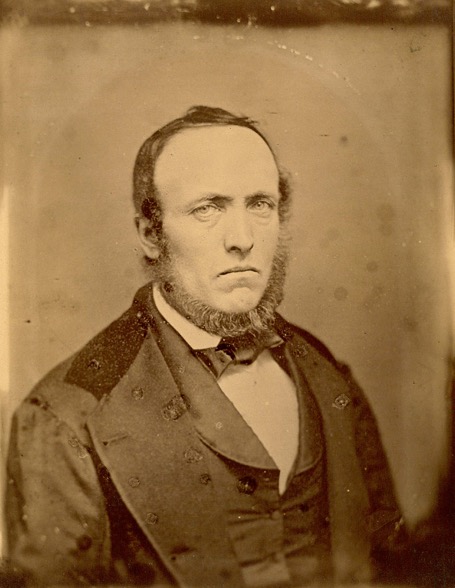 |
| Philip Libby Carter (1813 - 1876) |
It occurred to me
in the past few days to inquire of Joe Conover, our cousin and descendant of
Philip Libby Carter, if he might have the original of the Philip Libby Carter
list. With that request begins the Tale
of Two Papers in a Trunk.
None of this story
could be described today except for the dogged researching of Leslie A Carter
more than 60 years ago. Even though the
John and Hannah family was not his direct line, he was compelled to help
research our ancestor’s stories. His
ancestor, Richard Carter Jr (1780 – 1860) was a brother of our John
Carter. This Richard’s son, Varanes
Carter (1823 – 1909) moved from Maine and ended up in Tioga, Illinois, though he was not
a member of the LDS Church. Because of
Leslie’s family coming from Hancock County, he was acquainted with the remnants
of our family that continued to live there and thus his intense interest in our
family. In 1952 his journeys took him to
the home of Mrs. Dora Carter Bolt (the grandmother of Joe Conover) who lived in
Lima. It was on this visit with Dora
that she produced two documents for Leslie to view. For whatever reason Leslie didn’t take a
picture of either of these documents. If
he had had his camera with him, I am sure he would have copied them, so he must
not have been with camera that day.
The first of these
documents was previously described and the image of its transcription was
posted below in the former blog entry. In
1835 probably about the time of his leaving Maine for Massachusetts made a copy
of the family births. One would think
that he might have had access to a family Bible or he interviewed his mother. In any case he took with him in 1835 a list
of the births of his siblings.
The second of
these documents was an 1839 document transcribed by JCS. It reads as follows:
A
Family Record
Arlotte
L. Carter was born May 18 A.D. 1829
Lucinda
M. Carter was born January 14 A.D. 1831
Sidney
R. Carter was born August 29 A.D. 1834
Lydia
Ann Carter was born February 20 A.D. 1838
John
Carter was born May 19, A.D. 1783
Hannah
N. Carter was born October 4th 1786
Dora Carter Bolt
felt that the author JCS was non-other than James Chauncey Snow, Dominicus’
brother-in-law. The children listed
here were 4 of the children of Dominicus Carter and Lydia Smith. The list is incomplete as it leaves out two
children, Barrett and Sarah Emily, who had died previous to 1839. The mother Lydia herself, died on 24 Oct
1838. One has to think that the death of
Lydia must have precipitated the creation of this list. Why
James Chauncey Snow wrote this family
record and how it ended up in the possession of Dora is unknown. Regardless it ended up in Dora’s possession
probably as a result of the Mormons being driven out of Illinois. When the LDS part of the family left the area
in 1846 or so they may have left some documents with Philip for safe keeping,
or it may have been that after the LDS family homes were destroyed, it is
possible Philip and others may have searched for things that needed
saving. The Carter Hill home that Philip
lived in adjoined the little community of Morleyville so he would have been an
eye witness to what happed when the mobs destroyed his father and sibling’s
homes.
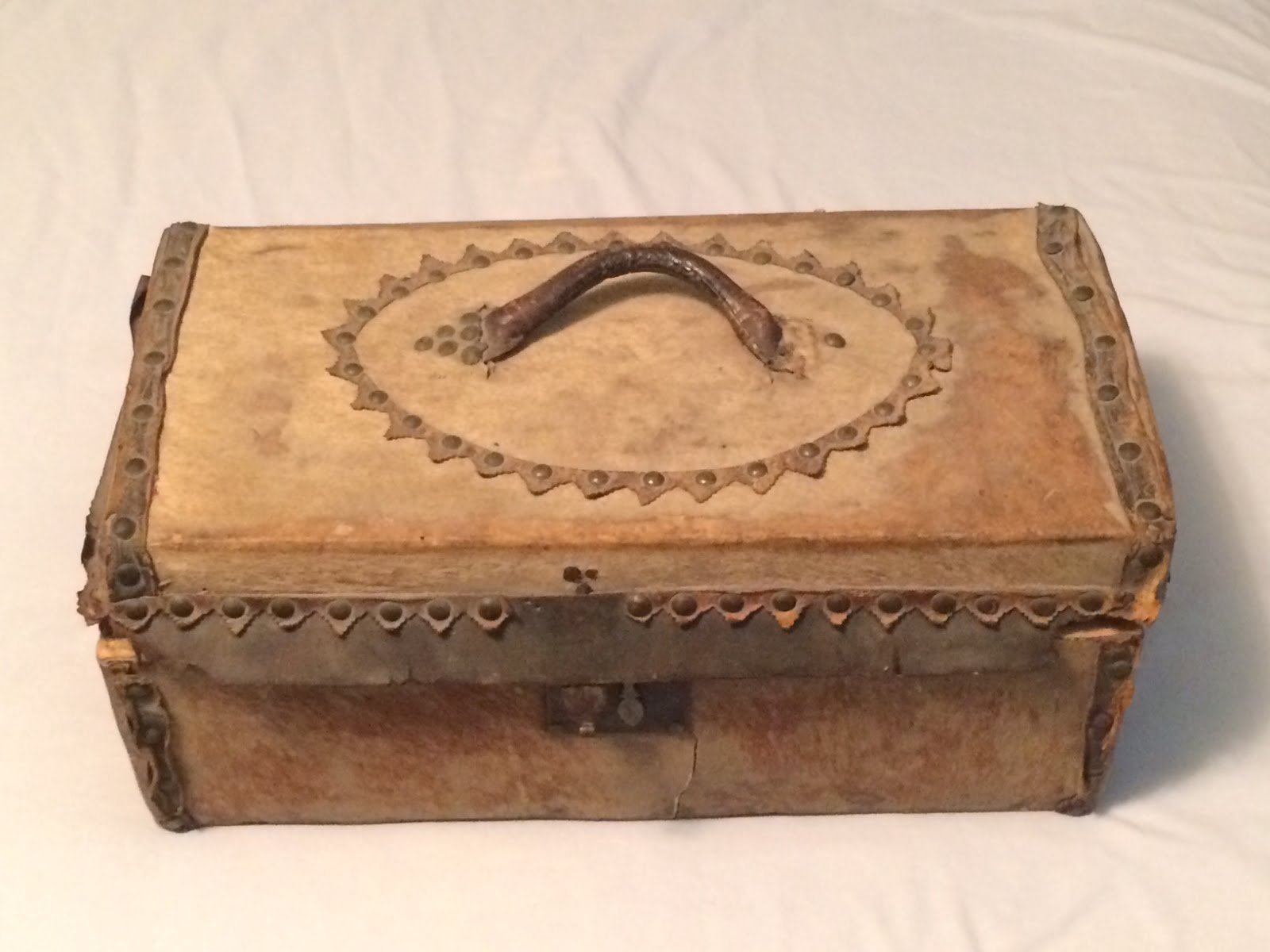 |
| The Old Deerskin Chest |
In any case after
that 1952 viewing by Leslie, these documents were probably returned to the old
family trunk where they resided, forgotten and deteriorating until literally
yesterday, when Joe Conover was able to locate them. This trunk – what of it? This is what Joe wrote about it: “The chest is 18 inches wide, 10 inches front
to back, and 7.5 inches deep on the outside and 5 inches deep inside. It is deerskin covered. The only history I know is that from my
earliest memory it was always inside a larger trunk in the storeroom at Carter Hill. My memory says Grandma Bolt said it was her
grandfather’s (i.e. Philip Libby Carter).
But my memory deceives me these days.
 |
| Inside lid of Chest |
There is some old writing on the inside of the
lid. Also some later pencil marks that
were probably put there by me or my siblings at some point. But I can make out the name Ella Dora and an
“86”. There are the words “Trunk of …”
but I can’t make out the rest … something like Jerad or Jezeb… Perhaps this means something to you. The name Ella Dora sounds familiar. I will
send a photo of the inside trunk lid.”
I am not positive who Ella Dora was but Philip Libby
Carter did have a daughter Dora Ella Carter who married Oliver Perry
Spencer. They lived and died in the
Tioga/Lima area. The Jerad or Jezeb
could possibly be Zebulon as Hannah’s father was Zebulon Libby. Possibly Hannah had received the chest from her
father, and used it to preserve important papers and records. When the Mormons left Nauvoo it would be
likely that this chest would be one of those items that Hannah just couldn’t
take with her, so she left it with her son, Philip Libby Carter. This is all supposition on my part but seems
to make sense.
In any case the old chest sat neglected until June,
2016 when these two treasures were found and through the graciousness of Joe
Conover, will be seen by most of our family for the first time in 160 years.
 |
| Dominicus Carter Family List of 1839 |
 |
| Philip Libby Carter Family List 1835 |
Saturday, June 4, 2016
LIFE OF JOHN CARTER – Part 8 – LIFE IN EARLY NEWRY, MAINE
John was in Newry for both the 1820 and 1830 census
enumerations. Though only the head of
households name is given, the family can easily be seen in each census. The 1820 census enumerated the family thusly
on 7 Aug 1820 ("United States Census, 1820" index and images,
FamilySearch (https://www.familysearch.org: accessed 26 February 2012). entry
for John Carter, residence Newry, Oxford, Maine; citing Census Records, FHL
microfilm 0,281,241; National Archives, United States Federal Archives and
Records Center, Washington D.C., United States:
 |
| 1820 Census for Newry, Oxford, Maine - John Carter |
Males under 10 – 4
(William 9, Philip 7, John Jr. 4 and Richard Harrison – just born – in fact the
census date must have been incorrect.)
Males 10 – 15 - 1 (Dominicus 14)
Males 26 – 44 - 1 (the father, John 38)
Females under 10 - 1 (Eliza Ann 2)
Females 10 –
15 - 2 (Almira 12, Hannah 11)
Females 26 –
44 - 1 (the mother Hannah 34)
The 1830 census
results in returns that closely fit the family but are not exact. The enumeration was as follows (Family
History Library Film 497946, Oxford County, Maine, page 202 – NARA publication
M19, NARA Roll 50):
 |
| 1830 Census of Newry, Oxford, Maine - John Carter |
Males 5 – 9 - 1 (Richard Harrison
9+)
Males 10 – 14 - 1 (John Jr 13)
Males 15 – 19 - 2 (William 19 and Philip
17)
Males 50 – 59 - 1 (the father, John 48)
Females 5 – 9 - 1 (Mary Jane 7)
Females 10 – 14 - 1 (Eliza 12)
Females 15 –
19 - 1 ?? (both Almira and
Hannah were married in 1829)
Females 40 – 49 - 1 (the mother, Hannah 44)
It should be noted
that the family home was beginning to empty as the children started to marry
and leave the home. Dominicus had
married 21 May 1828 to Lydia Smith and was enumerated next to his father on the
1830 census. Almira married Alvin Baron
Tripp on 15 Jan 1829 in Newry and their family was enumerated in Newry that
year. John and Hannah’s third child,
Hannah had recently married on 2 Dec 1829 in Bethel, Oxford, Maine to Aaron
Mereon York. (No record of them has been
found on the 1830 census. They were possibly living in someone else’s home that
year.)
So what was life
like in Newry from 1810 to 1830?
Summarizing all the books written on early Newry it was the consensus of
the writers that life in Newry was challenging in the least. Newry was on an important trail from the
coast at Portland to Errol, NH known today as Route 26. Still Newry was remote and to survive the
population of Newry had to be self-sufficient.
They had a saw mill for wood and a grist mill for flour. The families there were farms where most of
the food stuffs for the family were produced.
Quite frankly one writer summarized life as barely above the level of
subsistence.
 |
| 1818 Tax Roll for Newry, Oxford Maine |
John paid taxes in
Newry continuously from 1811 until 1838 when they moved west. The Newry Town Records contain a yearly
synopsis of the taxes levied on each family in the community. (It should be understood that whereas we pay
taxes on the land and buildings that we own, taxes in early Maine was based on
your livestock.) Though the things recorded varied from year to year a good
picture of the family can be drawn from these records. The general picture would be as follows: John usually had 2 oxen and (at least after
1820) 1 horse. He usually had from one
to 4 cows and 1 to 8 cattle. He usually
had two swine (though the number ranged from zero to 5 in different years. Until 1827 the records listed the land
holdings and usage of each family. From
1812 to 1815 he tilled (plowed) 1 acre.
From 1816 until 1822 he tilled 1.5 acres. From 1823 to 25 it was only .5 acre. In the last year land was listed (1827) he
tilled 1.5 acres. Beginning in 1814 he
mowed land (hay?). In 1814 it was a half
acre, in 1815 it was one acre and in 1816 it was 1.5 acres. Beginning in 1817 until the records stopped
in 1827 he mowed 2.5 acres. In 1821
they began to record pasture land and each year after that until 1827 he was
listed with 1 acre of pasture. He also reported
undeveloped land (probably forest) and this figure varied from a high of 230
acres to a low of 57 depending on the year.
The last kind of land reported was waste land and he again had various
amounts from 15 to 40 acres. This land
was probably swamp or other unusable land.
From the above you
get a good picture of a small family farm being operated for a family of about
11 people. The one or 1.5 acres of
tillage would have to supply the family with their food. They had a couple of acres of hay for the
small herd of cattle (dairy and beef), plus an acre of pasture on which to
raise them. They had a couple of oxen to
plow with and a horse for John to get around on along with a couple of pigs for
some pork. The vast majority of his land
was undeveloped but if this was forest they would supply trees for lumbering –
which would bring in much needed money.
(Next up will be a study of John's elective offices and responsibilities in Newry.)
Thursday, June 2, 2016
INVITATION TO JOIN OUR FAMILY ORGANIZATION
If you are not currently a member of our family organization - please a couple of minutes to click on the following link and provide us with your contact information. The link will also provide you with more information about the services we offer:
https://www.surveymonkey.com/
Thank you for taking the time to do this for us.
https://www.surveymonkey.com/
Thank you for taking the time to do this for us.
Wednesday, June 1, 2016
LIFE OF JOHN CARTER – Part 7 – HIS FAMILY MEMBERS AND THEIR NAMES
It is probably
smart that we step back from the chronological story of John Carter to discuss
the births and names of the family members.
To the best of my knowledge there is no family Bible that recorded this
family. If there was one, its existence
is unknown to me. In addition we have a
family who after 1834 and surely by 1846 was being scattered never to be a
single unit again. Efforts by the family
members to collect the family record began, as we know it with a list of the
family gathered by John’s son, Phillip, in December, 1835. William Furlsbury Carter, another son,
likewise collected this information it appears from Phillip in 1854 as he
returned from his mission to India. So
we have those two accounts from the family.
In addition we
have the records of Newry, Maine where the family had settled. It was in Newry
that the last eight of the children of John and Hannah would be born. Interestingly these records were not compiled
as the children were born but all in one group indicating that they were being
registered in the town records. This was
a common practice in New England towns that family groups were registered in a
town when they moved there or the town would occasionally gather the records of
families. Some towns would record children
as they were born in the community but an occasional listing was frequently
done in many towns. This could lead to
false assumptions of birth place and would usually leave off children who had
previously died.
 |
| Newry, Maine Town Record of Carter Family |
In 1821 or 1822
the Carter children were enumerated in Newry.
The original document reads:
Dominicus Son of John and Hannah Carter was born June 21, 1806.
Almira Carter Daughter of John and Hannah Carter was born January 3,
1808
Hannah Carter Daughter of J & H Carter was born June 23, 1809
William Carter Son of J & H Carter was born May 1, 1811
Philip Carter Son of J & H Carter was born January 17, 1813
John Carter Son of J & H Carter was born October 6, 1816
Eliza Ann Carter Daughter of J & H Carter was born September 28,
1818
Richard Harrison Carter Son of J &H Carter was born August 8, 1820
( Office of Town Clerk, Newry,
Maine, Town Records, 1805 - 1846, Family History Library Film #11589, pages
unnumbered.)
The first obvious
problem with this list the logical assumption that since this is a listing of
children born in Newry, that all of these children were born there. We have ample proof that the family did not
move to Newry until after the first three children were born. William was the
first of their children to actually be born in Newry. The second problem is that this is a list of
living children and they had lost one child born between Philip and John. The third problem is that this list is
incomplete as John and Hannah had two more children born after the record was
recorded. Because the town did not
record children as they were born in this era and the Carters would move before
another record would be made these last two children were never recorded in the
town of their birth.
We need now to
turn to the first of the two listings done by children of John and Hannah. The first is a record of Philip Libby
Carter. Philip had left Newry early (around
1835 or so) and had moved to Massachusetts.
There he worked at blacksmithing, married Martha Eames York (whose
siblings married William Furlsbury and Hannah Carter), and in May of 1851 moved
to Hancock County. I have not seen the
original of Philip’s listing of children but our early Carter research Leslie
A. Carter transcribed it on a visit to his cousin Dora Carter Bolt of Lima,
Illinois in 1952. He titled the document
“Transcript of Family Record of John and Hannah K. (Libby) Carter compiled by
Philip L. Carter. Date: Dec – 1853” The following is his record:
 |
| Philip L. Carter's List (Transcribed by Leslie A. Carter) |
The Record of
Dominicus Carter was Born June the 21st 1806
Almira Carter was Born January the 3d 1808
Hannah Carter was Born June 28, 1809
William Carter was Born May 1 1811
Philip L Carter was Born January the 17 1813
John H Carter was Born January 13, 1815
John Carter Jr. was Born October 6 1816
Eliza Ann Carter was Born September 28, 1818
Richard Carter was Born August 8, 1820
Mary Jane Carter was Born March 13, 1823
Rufus Carter was Born October the 9 1825
John Harrison Carter dyed April 11 1815
Rufus Carter dyed October the 9 1827
( Philip Libby Carter, List of Siblings recorded by Mrs. Dora Carter
Bolt and transcribed of a family record of John and Hannah K. (Libby) Carter
compiled by Philip L. Carter, dated Dec., 1835 – copy by Leslie Carter in
possession of Robert E. Givens, Clovis, CA.)
This is a
remarkable document as it includes all eleven children of John and Hannah. If
the date of creation if accurate he would have had his parent’s help in
creating this or maybe at that point there was a family Bible that he could
have copied.
Before doing an
analysis of this document, let’s address the 1854 version of the family
produced by William Furlsbury penned during his return from a mission to
India. The letter is addressed to his
wife Sarah and dated 5 Feb 1854 in Boston.
He had caught typhoid in India and had to leave his mission early. After asking to sail to New England , so he
could visit his family left behind there, he was allowed to make passage with a
ship sailing to Boston. He landed in
Boston on 10 November 1853. He spent the
rest of November with family in the Maine leaving for the West on 5 December
1853. Five days before Christmas in 1853
he arrived at Lima, Illinois where he visited with his siblings Philip, Mary
Jane and Almira. It was here that he
learned of the death of his father, John, and Jacob Dooley, Mary Jane’s
husband. William’s letter clearly says
Boston so he probably started to write it there but based on the date he was
most surely in Illinois when he finished it.
Since the listing of the children in his letter is almost identical I
suspect he copied the information from the list that Leslie A Carter
transcribed in 1952. Here is William’s
listing:
 |
| William F. Carter - Letter of 1854 listing siblings |
John Carter b. May 19, 1783 in Scarborough
Hannah N (sic) Carter b. October 9, 1786 in Scarborough
Dominicus Carter b. Jun 21, 1806 in Scarborough
Almira Carter b. January 3, 1808 in Scarborough
Hannah Carter b. June 28, 1809 in Scarborough
William F Carter b. 2 May 1811 in Newry
Phillip L Carter b. 11 January 1813 in Newry
John H Carter b. January 13, 1815 in Newry
John Carter Jr. b. October 6, 1816 in Newry
Elizann Carter b. September 23, 1818 in Newry
Richard Carter b. August 8, 1820 in Newry
Maryane Carter b. March 13, 1823 in Newry
Rufus Carter b. October 9, 1825 in Newry
John Harrison Carter died in ... Aprill (sic) 11,1815
Rufus Carter died in Newry October 9, 1827
(William Furlsbury Carter,
Letter: Boston (sic), to Sarah
Carter, 1854 Feb. 5, LDS Church History Library, MS 18978. Original letter donated to the Library by the
author of this work.)
We owe a lot to
Philip and William for compiling these lists.
Without them we might have had problems collecting the complete record
of this family. My grandmother, Christa
Lillis Wilkins Givens Damron, who was William’s granddaughter, wrote a moving
story of rereading the letter with William’s listing of the family in the 1930’s
or 40’s and realizing that her branch of the family had totally left Rufus Carter
out of this family group. So these lists
were of a great value to our early genealogists.
One more topic
ought to be addressed at this time:
Names! There have been issues for
what seems forever over the actual names of some of the members of this family. First I would like to point out that the
exactness of names as we perceive them now, has not always been that way. An
illustration of this can be drawn from my mother’s family. My mother was named Jennie Elizabeth after
her grandmother. The only problem was
her grandmother, Jennie Elizabeth Beck Sands, was actually born Elizabeth Jane
Beck and changed her name in 1870 when she married my great grandfather. So
were names in those days. People often
changed or altered their names. With
this in mind let’s visit a few names in this family:
John Carter – I have done extensive research on John and have never
seen a middle name or initial for him in any document that I have viewed. Yet in the family is a tradition that his
name is really John C Carter. If that is
claim could be substantiated by records held by others I would love to have you
step forward and let us see the documentation.
William (Furlsbury) Carter – Now William is my 2nd great
grandfather so I feel vested in studying him.
I really think he was born William Carter. The Furlsbury never appears before the
Illinois period of his life. I think at
that point he made up a middle name to differentiate him from the other William
Carters in the Church.
John (Harrison) Carter (Jr.) – This second John in the family, born
after the first John H. died in 1816 was apparently born just John Carter
Jr. He was known by that all the way
through the Nauvoo years and it was only after then that he started using John
Harrison Carter as his name.
Now that the
family of John Hannah has been established, we need to move on the John’s life
in Newry.
Subscribe to:
Posts (Atom)